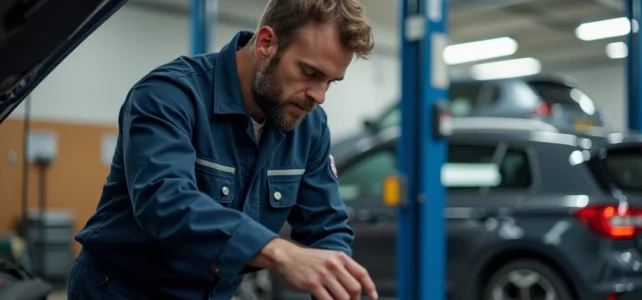
In Belgium, the car market is undergoing a rapid technical transformation. Electrified powertrains now account for more than half of new registrations in the first half of 2026, diesel continues to decline, and a reform of the technical inspection comes into effect starting September 2026. These three factors are changing both the maintenance costs, the purchasing criteria, and the resale value of a vehicle.
Belgian Technical Inspection Reform: What Changes in 2026 and 2027
The regulatory framework for technical inspection in Belgium will see two major changes in the short term. Understanding their implications allows for better anticipation of costs and procedures related to vehicle ownership.
You may also like : Everything You Need to Know About the Dimensions and Height of the Renault Master L2H2 in 2026
Starting from September 1, 2026, all passenger cars over four years old will only need to undergo technical inspection once every two years, regardless of age or mileage. The previous limit (10 years or 160,000 km) that required an annual inspection will be eliminated. For drivers who cover a lot of mileage, this removal reduces the frequency of visits, but it does not exempt them from rigorous mechanical monitoring between inspections.
The second change concerns private sales. As of January 1, 2027, the mandatory pre-sale inspection will be abolished for vehicles sold in Belgium, while it remains in place for imports. The Car-Pass will still be mandatory. In practical terms, a buyer will no longer be able to rely on a recent technical inspection as a safety net during a transaction. Having the vehicle inspected by an independent mechanic before signing will become an even more necessary reflex.
Read also : Everything You Need to Know About Tie Dimensions and Sizes to Make the Right Choice
To keep up with these developments and compare market offers, it is useful to consult information on Auto Tech before making a purchase or maintenance decision.

Belgian Car Market in 2026: The Shift to Electrification
The Belgian new car market is stabilizing in volume, but its internal structure is changing profoundly. In the first half of 2026, electric cars account for 36.1% of registrations. Electrified powertrains in the broad sense (100% electric, plug-in hybrids, conventional hybrids) represent 54% of new registrations.
Two trends deserve particular attention:
- Plug-in hybrids are experiencing a significant decline, with a drop of 36.7% compared to the same period. The gradual end of tax benefits for plug-in hybrid company cars largely explains this retreat.
- Diesel continues to fall (-21%), making the resale of a used diesel vehicle aged 5 to 15 years increasingly complicated, particularly due to low emission zones (LEZ) like that of Brussels.
- Gasoline remains a favored transitional option for individuals who cannot yet switch to electric due to a lack of home charging stations or sufficient budget.
This shift has a direct impact on the used car market. A diesel vehicle purchased today is likely to lose value faster than a gasoline or conventional hybrid model, simply because traffic restrictions are tightening each year in major Belgian urban areas.
Maintenance Costs: Comparing Gasoline, Hybrid, and Electric
The transition to an electrified powertrain is not limited to the purchase price. Routine maintenance varies significantly depending on the type of powertrain, and this difference affects the total ownership budget.
Maintenance of a Thermal Vehicle in Belgium
A gasoline or diesel vehicle requires an oil change and oil filter replacement on average every 15,000 km or once a year. Major maintenance (air filters, fuel filters, spark plugs, timing belt depending on the model) typically occurs every 30,000 km or every two years. These costs are in addition to brake pads, discs, and tires, which are common to all powertrains.
Maintenance of an Electric Vehicle
A 100% electric vehicle eliminates several expense items: no oil changes, no fuel filter, no timing belt, no clutch. Regenerative braking also reduces brake pad wear. The main remaining costs are tires (which can wear out faster due to instant torque), brake fluid, and cabin filters.
The annual maintenance cost of an electric car is significantly lower than that of an equivalent thermal model. This savings partially offsets the higher purchase price, especially over a holding period of five years or more.
The Case of the Conventional Hybrid
The non-plug-in hybrid retains a thermal engine and thus the same maintenance constraints (oil changes, filters, belts). Regenerative braking reduces brake wear, but the maintenance savings remain modest compared to a 100% electric vehicle.

National Car Sticker: A New Budget Item to Anticipate
The Belgian authorities are preparing a new national car sticker. This system, which could reach up to 125 euros per year, would also apply to foreign drivers circulating on the Belgian network. For residents, this sticker would be in addition to the existing registration tax and annual circulation tax.
The impact on the annual automotive budget is not negligible. Combined with insurance, fuel or electricity, maintenance, and any leasing monthly payments, this sticker increases the total cost of ownership. Comparing the overall cost over several years remains the only reliable way to choose between purchase, leasing, or used.
The Belgian car market in 2026 rewards buyers who take the time to check three elements before signing: the vehicle’s compatibility with low emission zones in their area, the actual maintenance schedule of the targeted model, and the regulatory evolution of technical inspection that eases certain obligations while removing safeguards for used car buyers.