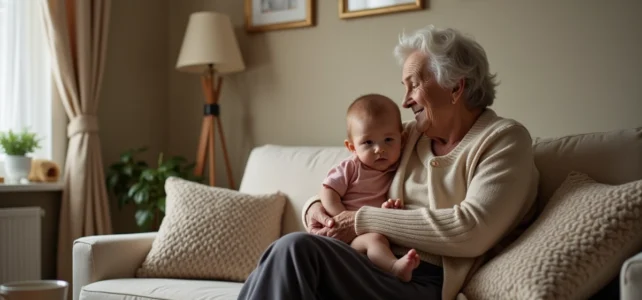
The term “exhausted grandmother syndrome” is increasingly circulating in discussions about parenting and family support. It describes a state of physical and psychological weariness affecting grandparents, predominantly women, who are engaged in intensive caregiving for their grandchildren. Far from being just a temporary fatigue, this phenomenon is akin to caregiver burnout and raises questions about the limits of intergenerational support.
Intensive Grandchild Care: An Unrecognized Caregiver Role
Most content on family exhaustion focuses on parents, particularly mothers. The case of grandparents remains sidelined, even though their daily involvement often exceeds the scope of occasional help.
Further reading : Tips and advice for saving water daily and preserving the planet
The article from Marie France reports that the “slave grandparent syndrome” is described as a disease of the 21st century. The World Health Organization considers it an abuse of the grandparent role, a form of mistreatment when availability is no longer a choice but an implicit obligation. This institutional qualification clearly distinguishes this phenomenon from occasional babysitting.
According to data relayed by BBC Africa, the professional precariousness of parents fuels the overcommitment of grandparents. When adult children struggle to balance work and family life, caregiving shifts to the previous generation, without anyone naming this burden for what it is: unpaid caregiver work. To better understand the exhausted grandmother syndrome, one must first recognize the economic dynamic that underpins it.
You may also like : How to Choose the Right Size S: Essential Size Guide and Correspondences

Symptoms of Burnout in Grandparents: Spotting Exhaustion Before Collapse
Stress, anxiety, exhaustion, and insomnia are among the most common symptoms in grandparents after long periods of caregiving. These signs are documented but rarely associated with the grandparent role in mainstream literature.
The confusion arises from the fact that these symptoms overlap with those of normal aging or age-related depression. A grandmother who sleeps poorly, loses her appetite, or gradually isolates herself may not always be identified as a caregiver in burnout. Her surroundings may attribute these changes to age rather than overload.
Physical and Emotional Signals to Watch For
- Persistent fatigue that does not resolve with rest, accompanied by unusual muscle or joint pain related to the repetitive actions of caregiving (lifting, bending, running)
- Increasing irritability towards grandchildren or adult children, followed by a sense of guilt that prevents expressing limits
- Loss of interest in personal activities (outings, hobbies, social life) in favor of a schedule entirely organized around family needs
- Recurring sleep disturbances, with nighttime awakenings related to anticipating upcoming caregiving days
The accumulation of these signs over several months distinguishes structural exhaustion from temporary fatigue. Parental burnout is now better documented among direct parents, but the mechanisms are comparable in grandparents.
Family Pressure and Guilt: The Trap of Silence
One rarely addressed aspect concerns the guilt mechanism that prevents grandparents from setting limits. Cayetana Campo, quoted by BBC Africa, explains that she warned her four children from the start that she would not be a full-time caregiving grandmother. This preventive approach remains rare.
The fear of family judgment plays a major role. Refusing to care for grandchildren is perceived as a lack of love, not as an act of preservation. This unspoken social norm transforms volunteering into obligation. Grandparents who try to reduce their availability face misunderstanding, even anger, from their own children.
Field reports vary on this point. Some families manage to redefine roles after an open discussion. Others become stuck in a pattern where the grandmother silently compensates for the shortcomings of the caregiving system, until total exhaustion.
Concrete Solutions Against Grandparent Exhaustion
Addressing the exhausted grandmother syndrome requires intervention at multiple levels. The difficulty lies in the fact that the person concerned is often the last to ask for help.
Establish a Clear Framework with Adult Children
The first step involves an explicit conversation about the frequency and duration of caregiving. Defining a number of days per week protects both the relationship and health. This framework prevents the gradual escalation where “just Tuesday” becomes “Tuesday, Thursday, and the weekend.”
Utilize Existing Respite Services
Respite solutions for caregivers, referenced notably by monparcourshandicap.gouv.fr, do not specifically target grandparents. However, the principles are transferable: daycare centers, part-time nurseries, occasional home help. The goal is to reintroduce regular recovery periods into the week.
- Identify accessible collective care structures in the community to reduce days of direct solicitation
- Plan non-negotiable vacation periods without caregiving, scheduled in advance
- Consult a healthcare professional (primary care physician, psychologist) as soon as symptoms of chronic stress appear, without waiting for collapse

Acknowledge the Legitimacy of Refusal
The right to say no does not require medical justification. A grandparent who preserves their energy remains available longer for their grandchildren, under better conditions. The alternative is total exhaustion followed by a sudden withdrawal, which is far more damaging for everyone.
The exhausted grandmother syndrome is not an individual fate. It is a symptom of a familial and social imbalance where childcare relies on the goodwill of a generation that does not always have the physical resources to manage it. Naming the problem remains the prerequisite for families to find viable long-term arrangements.