
A well-tailored suit, a fitted shirt, and yet something is off. The tie stops halfway down the stomach, or worse, it extends several centimeters beyond the belt. This visual discrepancy rarely comes from a bad knot. It stems from a tie whose dimensions do not match either the stature or the collar of the jacket.
Pre-tied tie: unique dimensions that change the benchmarks
Let’s start with a case that most guides overlook. Pre-tied zipper ties, used for professional contexts (hospitality, security) or ceremonies, do not follow the same proportions as a classic tie at all.
Further reading : Everything you need to know about car maintenance, purchasing, and news in Belgium
A pre-tied tie can measure about 42 cm in length (from the tip to the knot) with a maximum width of 7.5 cm. This is far from the 145 cm of a standard tie. Since the knot is fixed, there is no margin for adjustment through tying techniques.
In practice, if one buys a pre-tied tie without checking these measurements, one ends up with a too-short end for a tall man, or a disproportionately large knot in relation to the shirt collar. Checking the total length and width of the end before purchase avoids this common mistake.
See also : Everything You Need to Know About the Dimensions and Height of the Renault Master L2H2 in 2026
Standard length and XL tie: concrete benchmarks by stature
The standard length of a tie is around 145 cm. To understand the dimensions and size of ties, one must first know that this measurement corresponds to an average-sized man, with a simple knot or a four-in-hand.
Tall or stocky men consume more fabric when tying. The back end rises, the front end shortens, and the tip ends up above the navel. For these body types, models in extra length go up to 160 cm.
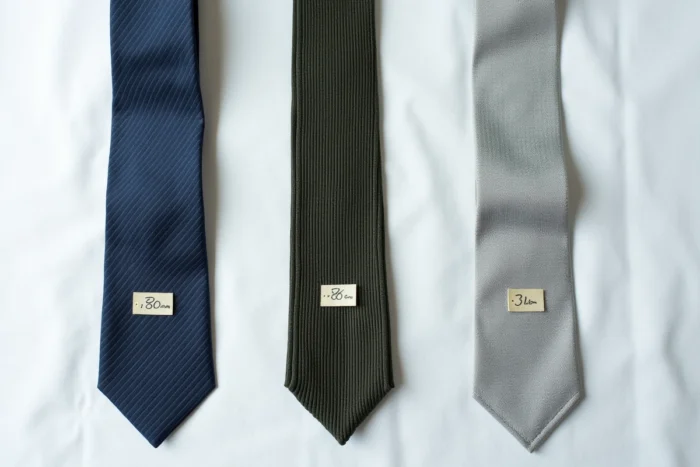
This is not a luxury. A man over one meter eighty-five often needs an XL tie for the tip to reach the top of the belt, which remains the visual reference point.
The knot consumes fabric, and not just a little
A Windsor knot absorbs significantly more length than a four-in-hand. On a 145 cm tie, switching from a simple knot to a Windsor can shorten the visible end by several centimeters. This is enough to disrupt the balance of the silhouette.
Before concluding that a tie is too short, one should try a less bulky knot. If the problem persists, the tie is simply not suited to the stature.
Tie width: the real criterion is the jacket lapel
The width is measured at the widest point of the front end. The common categories on the market are as follows:
- Slim tie: between 5 and 6 cm, suitable for narrow lapel jackets and slim silhouettes
- Classic tie: between 7 and 8.5 cm, the most versatile format for standard cut suits (Cinabre, for example, offers its models in this range)
- Wide tie: over 9 cm, reserved for wide lapels and looser cuts
The width of the tie must match the width of the lapel. A slim tie on a suit with wide lapels creates a glaring imbalance. Conversely, a 9 cm tie on a fitted suit with small lapels gives a bulky and dated effect.
The shirt collar also plays a role
An Italian spread collar frames a wide knot well, thus a classic or slightly wide tie. A button-down collar or a tight cutaway collar pairs better with a slim or fine classic tie. Opinions vary on this point according to preferences, but the rule of proportion remains reliable: the knot should never extend beyond the space between the collar points.
Fabric and thickness: the impact on the drape and volume of the knot
We talk a lot about length and width, but the thickness of the fabric also modifies the final appearance. A lined silk tie produces a compact and neat knot. A wool or knit tie, with thicker material, inflates the knot and consumes more length when tied.
If one regularly wears wool ties (very common in autumn-winter), it is better to plan for an extra half centimeter in length compared to what one would choose in silk.
- Smooth silk: thin knot, fluid drape, moderate fabric consumption when tying
- Wool or cashmere: bulkier knot, need for a slightly longer tie
- Cotton or synthetic knit: variable thickness, test the knot before cutting the tag
The fabric conditions the choice of length as much as stature does. Two ties of 148 cm, one in fine silk and the other in thick wool, will not drape the same way on the same man.
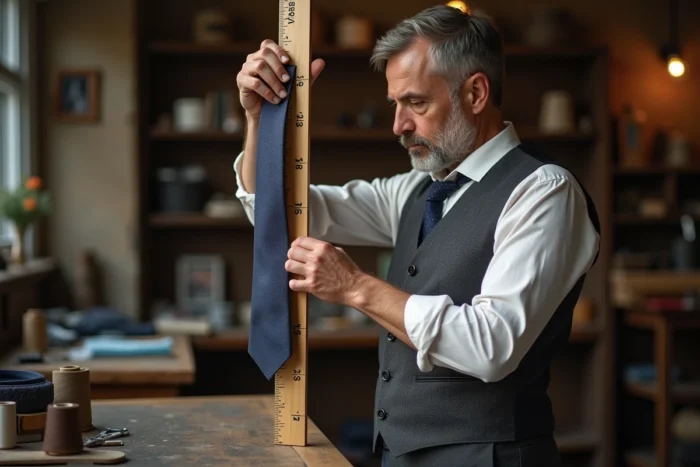
Summary table: common dimensions by type of tie
| Type | Length | Width | Main use |
|---|---|---|---|
| Slim | ~145 cm | 5-6 cm | Fitted suit, slim silhouette |
| Classic | ~145-148 cm | 7-8.5 cm | Standard suit, professional context |
| XL / Extra length | ~155-160 cm | 7-8.5 cm | Tall or stocky man |
| Pre-tied | ~42 cm (visible end) | ~7.5 cm | Uniform, quick ceremony |
This table covers the majority of cases. For an atypical body type (very tall and very thin, or stocky and average height), cross-referencing length and width with the type of knot planned gives the most reliable result.
The last point to remember: a tie should not be chosen alone. It should be tried on with the shirt and jacket that will be worn. The theory of dimensions provides a framework, but it is the mirror, with the suit on, that validates the choice.