
On a a Peugeot 208, reconnecting a new battery is not enough to restore normal operation. The power cut erases settings stored by the control units, and some equipment requires a manual reset. You often end up with a warning light on, an inactive Start-Stop, or windows that no longer work automatically, without understanding why. Here are the concrete checkpoints not to overlook.
Battery and control unit coding: the point most guides ignore
On 208 models equipped with the Start-Stop system, installing a new battery without declaring it to the control unit poses a real problem. The battery management system (BMS) continues to manage the charge according to the parameters of the old battery, which skews the charging strategy and may prevent the reactivation of the Start-Stop.
You may also like : Essential Steps for Successfully Conducting a Network Security Audit in a Business
Registering the new battery in the control unit allows the system to adapt its charging cycles to the actual state of the accumulator. Without this registration, the BMS considers the battery to be worn out and restricts certain functions to preserve energy.
Specifically, you need a compatible diagnostic tool (such as Diagbox at Peugeot, or a multi-brand tool that manages the PSA protocol). The operation takes a few minutes: you enter the capacity, the technology (EFB or AGM), and sometimes the serial number.
You may also like : How to Sell a House Quickly After a Divorce: Tips to Attract Buyers
All the elements to check after changing the battery on a Peugeot 208 partly depend on this initial step. Feedback varies by model year, but on recent versions, skipping this step remains the most common pitfall.
Resetting electric windows and openings on the 208
The power cut erases the position memory of the window lifters. Result: the one-touch up/down function no longer works. You press the control, the window goes up, but you have to keep the button pressed continuously.
The re-learning procedure is simple but must be done window by window:
- Raise the window fully while holding the button, then hold it for another two to three seconds after reaching the top stop
- Lower the window fully while holding the button, then hold it for another two to three seconds after reaching the bottom stop
- Repeat the operation on each door equipped with a control
If a sunroof is present, it requires the same manipulation. Without this re-learning, the anti-pinch function remains inactive, which poses a real safety risk, especially with children on board.
Dashboard warning lights and persistent error messages after battery replacement
After reconnecting, it happens that several warning lights come on simultaneously: airbag, power steering, anti-pollution. In most cases, these indicators disappear after a complete driving cycle (starting, driving for a few kilometers, stopping the engine, then restarting).
If a warning light persists beyond two cycles, you are facing a stored fault that requires erasing with a diagnostic tool. The engine warning light (MIL) associated with the anti-pollution system is the most common. Disconnecting the battery interrupts the OBD monitoring cycle, and the control unit restarts its compliance tests.
An airbag warning light that stays on after battery replacement does not necessarily indicate a fault in the restraint system. The control unit has simply lost its communication temporarily. Generally, erasing the codes is sufficient. However, if the light returns after erasure, you should look for a real connectivity issue.
The case of the Start-Stop that refuses to reactivate
The inactive Start-Stop after battery replacement is the most reported symptom by 208 owners. The system needs specific conditions to function: battery declared as new in the control unit, engine temperature reached, sufficient battery charge. Without the coding mentioned above, the Start-Stop may remain disabled indefinitely.
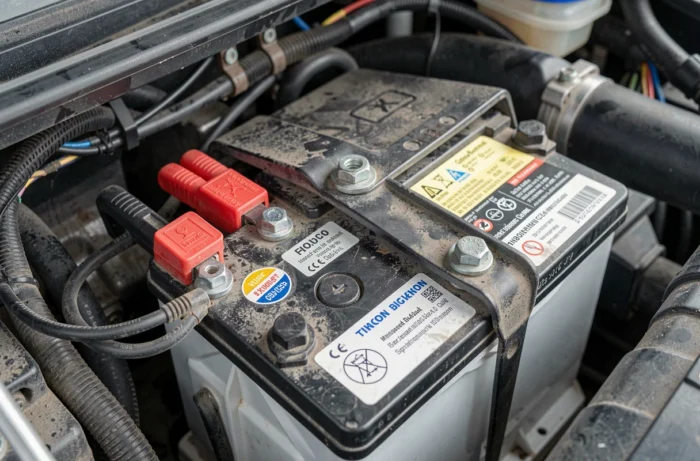
Visual inspection of the battery compartment: terminals, clamp, and tray
This inspection takes two minutes and prevents false contacts in the following weeks. On the 208, the battery is located on the right side of the engine compartment, under the brake fluid reservoir. The space is tight, and a poorly secured battery can end up moving.
The points to inspect after installation:
- Clamp securely tightened, with no lateral play of the battery
- Clean and well-tightened terminals, with no signs of sulfate (whitish or greenish deposits)
- Positive terminal with its protective cover in place to avoid any accidental short circuit
- Battery tray free of cracks or signs of acid from the old accumulator
Oxidized terminals cause micro-cuts that disorient the control units and generate phantom faults that are impossible to reproduce in the workshop. A cleaning with fine sandpaper before reassembly eliminates this risk.
Radio, clock, and comfort settings: the classic oversights
The radio often reverts to locked mode after a power cut. On 208 models equipped with an original unit, the unlock code is found in the owner’s manual or on a label in the glove compartment. Without this code, you end up with a screen displaying “CODE” and no sound.
The dashboard clock systematically resets. The preset radio stations disappear. The automatic climate control preferences revert to factory settings.
On versions with parking assistance, the sensors resume normal operation after a driving cycle. But if the system displays a persistent unavailability message, a diagnostic check is necessary to restart the calibration.
Replacing the battery on a 208 is not limited to a mechanical exchange. The amount of onboard electronics in this model transforms a simple operation into an intervention that affects several systems. Taking ten minutes to check each point avoids unnecessary trips to the garage.