The EAT8 automatic transmission, manufactured by Aisin and installed in many Peugeot, Citroën, DS, and Opel models, has a reputation for reliability. The manufacturer even claims it requires no fluid changes. However, specialized transmission workshops tell a different story, and user feedback beyond 50,000 km confirms that the durability of this transmission primarily depends on its fluid change history.
EAT8 Transmission and Oil Wear: What Really Happens Inside the Case
The EAT8 is a torque converter transmission with eight gears. The converter, a hydraulic component located between the engine and the transmission, generates heat during every slipping phase, particularly at startup and in traffic jams.
This heat gradually degrades the ATF (Automatic Transmission Fluid). Metal particles from the normal wear of gears and internal clutches accumulate in it. The filter retains some of these debris, but its capacity is not infinite.
When the oil loses its properties, the solenoids (the small electrically controlled valves that manage each gear shift) begin to stick or respond with a slight delay. The concrete result: jerks during gear shifts, especially when cold. These morning jerks are the first warning sign of an EAT8 with worn oil.
Usage feedback compiled from vehicles over 50,000 km shows that these small cold jerks do not worsen if the oil is kept in good condition. However, ignoring the problem for tens of thousands of additional kilometers can lead to much more significant repairs.
Scheduling the maintenance and fluid change of the EAT8 according to the recommendations of transmission specialists remains the best insurance against silent degradation.
EAT8 Fluid Change Interval: Why the Manufacturer and Specialists Don’t Agree
Stellantis (the group that oversees Peugeot, Citroën, DS, and Opel) states that the EAT8 transmission is lifetime lubricated. Aisin, the Japanese manufacturer of the transmission itself, recommends a fluid change every 60,000 to 80,000 km.
Why this discrepancy? The car manufacturer reasons based on warranty duration and standardized testing conditions. The transmission manufacturer considers the mechanical lifespan of the component, regardless of usage conditions.
Specialized workshops now systematically follow Aisin’s recommendation. They actually apply the same interval to all Aisin 8-speed transmissions, including those installed in Volvo vehicles or other brands.
Severe Usage: When to Shorten the Interval
Do you mainly drive in the city, with short and frequent trips? Do you tow a trailer or a van? Do you regularly load your vehicle to full capacity? These conditions are classified as severe usage by Aisin.
In this case, aiming for the lower end of the range (around 60,000 km) is preferable. The slipping phases of the converter are more frequent in the city than on the highway, which accelerates the degradation of the oil.
Static or Dynamic Fluid Change: The Choice That Changes Everything
There are two methods to replace the oil in an EAT8 transmission. They are not equivalent at all.
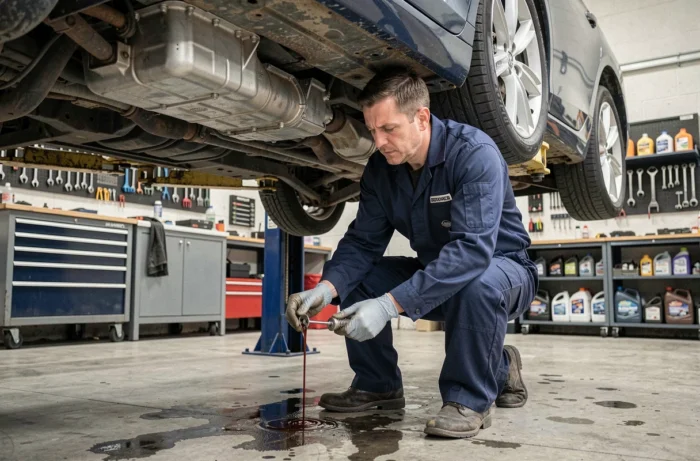
- The static fluid change involves opening the drain plug and letting the oil flow out by gravity. It only replaces part of the fluid (about half), as a significant amount remains trapped in the torque converter and internal lines.
- The dynamic fluid change using specialized machinery circulates new oil through the system while the engine is running. It allows for the replacement of nearly all the fluid, including that in the converter. The result is significantly cleaner.
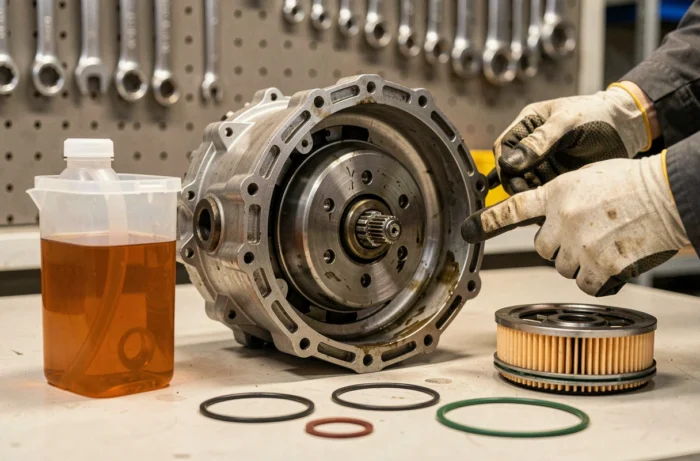
- Replacing the filter and the pan (often molded as a single piece on the EAT8) completes the intervention. A saturated filter limits the effectiveness of the new oil, making replacement relevant at every complete fluid change.
The dynamic change is more expensive, but it offers far superior cleaning. For a transmission that has never been changed beyond 80,000 km, the dynamic method is highly recommended by specialists.
Electronic Reset After the Intervention
After each fluid change, the EAT8 transmission must undergo a reset using a diagnostic tool. This step recalibrates the adaptation points of the transmission: the transmission relearns the filling times of each clutch with the new oil. Without this reset, the gear shifts remain set to the parameters of the used oil, which can cause paradoxical jerks immediately after the fluid change.

Cost of an EAT8 Fluid Change: Factors That Affect the Bill
The observed prices vary significantly, from less than 300 euros to nearly 950 euros. This discrepancy is explained by several concrete factors:
- The type of fluid change (static or dynamic): the dynamic requires dedicated machinery and more time.
- The volume of ATF used: a dynamic change consumes more liters than a gravity change.
- The replacement or not of the filter and the pan: this item represents a significant portion of the total cost.
- The hourly rate of the workshop: a specialized transmission center and a dealership do not apply the same pricing structures.
A key point to remember: a complete fluid change costs a fraction of the price of a transmission replacement. Major repairs on an EAT8 (replacement of the torque converter locking mechanism, internal clutches) reach amounts that are incomparable to a preventive fluid change.
Choosing the Right ATF for an EAT8
The EAT8 requires an ATF fluid approved for its specific transmission reference. Using a generic fluid or oil intended for another Aisin transmission can cause malfunctions. The specifications to be followed are those indicated by Aisin for this generation of 8-speed transmission.
The total amount of fluid in the system far exceeds what drains during a static change. Respecting the prescribed volume and filling temperature is crucial for the proper functioning of the transmission. An insufficient or excessive fill alters internal pressures and disrupts gear shifts.
The EAT8 remains a reliable component when its oil is treated as a wear item, not as an eternal liquid. Owners who follow Aisin’s recommendation for periodic fluid changes experience smooth gear shifts well beyond 150,000 km, whereas those who have never changed the fluid begin to accumulate troublesome symptoms.