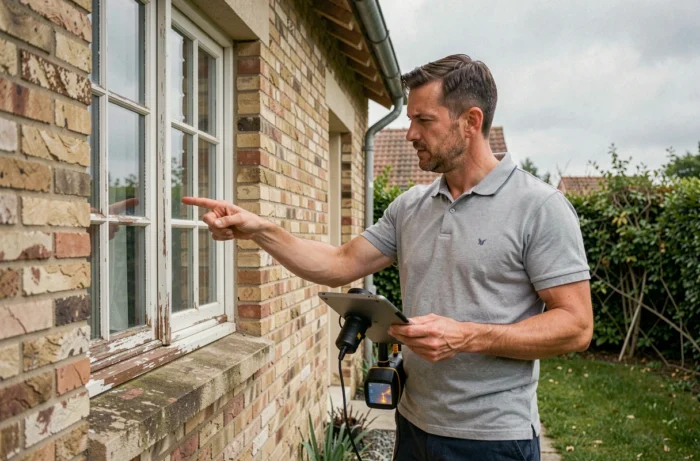
You heat your home all winter, the bill rises, and you wonder where to start to improve the situation. Before choosing insulation or a heat pump, the first step is to assess the building’s weaknesses.
This is the role of the energy audit, a thorough diagnosis that identifies heat losses and proposes a detailed work plan. In 2026, several subsidies are available to finance this audit and the resulting renovations, provided that a specific pathway is followed.
Closure and reopening of MaPrimeRénov’: what 2026 has changed for the audit
The beginning of 2026 surprised many homeowners. MaPrimeRénov’ was temporarily closed before reopening on February 23, 2026, with a focus on two distinct pathways.
The first, called gesture pathway, finances isolated equipment such as decarbonized heating. The second, the accompanied large-scale renovation pathway, requires the completion of an energy audit and the use of a certified Mon Accompagnateur Rénov’ guide.
Specifically, if you aim for a significant performance gain (moving from an F to a C rating on the energy label, for example), this accompanied pathway must be taken. The audit is then not an option: it conditions access to the highest aids. To better understand the mechanism linking the energy audit and Habitatfuturvert aids, it is necessary to distinguish what pertains to the diagnosis from what pertains to the financing of the work itself.
The 2026 scales are generally stabilized compared to 2025, with a cumulative ceiling maintained at 20,000 euros per housing unit over five years. This stability is intentional: Anah has chosen not to modify the amounts to provide visibility to households preparing their applications.

Mandatory France Rénov’ appointment before the energy audit
Since 2026, obtaining funding for the audit is no longer just about filling out an online form. An additional step has been added to the process: a preliminary appointment with a France Rénov’ advisor.
Why this requirement? Because many households were undertaking audits without knowing their actual rights, only to discover too late that they did not meet all the criteria. The appointment serves to verify eligibility, direct to the appropriate pathway, and avoid unnecessary expenses.
Here’s what the advisor examines during this step:
- The housing situation: year of construction, type of heating, last known energy performance certificate (DPE) label. These elements determine whether the gesture pathway is sufficient or if the large-scale renovation is more appropriate.
- The household income: income ceilings condition the coverage rate. A household with modest income accesses a higher rate than a household with intermediate income.
- The regulatory timeline: a landlord whose property is classified as G must anticipate the rental ban. The advisor incorporates this deadline into the planning.
This appointment is free. It can be made online or by phone with the France Rénov’ advisory space in your department.
Cumulative subsidies to finance the audit and work in 2026
The energy audit represents a significant cost for a single-family home. MaPrimeRénov’ covers part of this expense, but the amount depends on the applicant’s income category.
MaPrimeRénov’ for the audit itself
In the accompanied pathway, the audit is financed within the overall aid envelope. It is not treated as a separate item: its cost is included in the calculation of the coverage rate applied to the entire project. The professional conducting the audit must be RGE certified (recognized guarantor of the environment).
Energy savings certificates and local aids
The CEE (energy savings certificates), provided by energy suppliers, complement MaPrimeRénov’. They apply to the work itself, not to the audit, but reduce the overall remaining charge of the project.
Some local authorities add their own schemes. These local aids vary from one municipality to another and are not always included in national simulators. A call to the town hall or intercommunal authority can verify what exists in your area.
Last often overlooked lever: the zero-interest eco-loan finances the remaining charge without interest, within the limit of a ceiling set by regulations. It is cumulative with MaPrimeRénov’ and the CEE.
Changes from September 2026: removed gestures and exclusion of fossil fuels
Since September 1, 2026, several changes have come into effect. Gestures previously eligible for the single-gesture pathway have been removed from the list. Systems operating on fossil fuels are now excluded from the MaPrimeRénov’ scheme.
In practice, this means that a high-performance gas boiler no longer qualifies for aid, even for a replacement. The message is clear: only decarbonized equipment remains subsidized (heat pumps, biomass boilers, combined solar systems).
This tightening reinforces the usefulness of the energy audit. A well-conducted audit identifies solutions compatible with the 2026 criteria and avoids committing to equipment that will no longer be subsidized at the time of application submission.
Energy audit in co-ownership: a different process
In co-ownership, the audit does not follow the same circuit. The MaPrimeRénov’ Copropriété scheme finances work on common areas, and the audit is carried out by the co-ownership syndicate.
The vote in the general assembly remains a prerequisite. The audit is then conducted at the scale of the entire building, which reduces the cost per unit. The accompanied pathway also applies, with the intervention of a project management assistant.
For co-owners, the challenge is to coordinate the timeline: the delays between the vote, the audit completion, and the submission of the aid application can stretch over several months. Anticipating from the next general assembly avoids losing a complete cycle.
The landscape of renovation aids remains dense, but the logic of 2026 can be summarized in a sequence: France Rénov’ appointment, certified audit, then grouped application for subsidies. Each step conditions the next. A homeowner who follows this order accesses the maximum available funding, without unpleasant surprises at the time of file processing.