When you start looking for a venue that can host guests over two days, you quickly realize that weddings in 2026 are no longer planned the same way as five years ago. The average budget in France now reaches 19,921 euros, nearly double what it was twenty years ago.
This increase reshuffles priorities: the meal can account for up to 40% of the total, far ahead of decoration or attire. Organizing a wedding this year means first accepting to make clear trade-offs between the items that truly matter to the couple and those that can be lightened.
Related reading : Practical tips for organizing a stress-free move and successfully settling in
Wedding Budget 2026: Where the Money Really Goes
The first instinct when setting a total budget is to divide it equally among the major categories. In practice, this doesn’t work. The meal takes the largest portion of the budget, and costs related to flowers and raw materials continue to rise year after year.
In concrete terms, it’s wise to secure the caterer as a priority. The price per guest dictates everything else: the size of the guest list, the choice between a buffet and a seated meal, and the margin left for floral decoration. Reducing the guest list by ten people often frees up more budget than changing providers.
You may also like : Essential Trends and Tips for Organizing an Unforgettable Wedding This Year
The influence of social media also weighs on expectations. Couples compare their preparations to highly staged weddings seen on Instagram or Pinterest, which drives quotes upward.
A more realistic approach is to identify three strong visual elements (the ceremony arch, the head table, the photo booth area) and concentrate the decoration budget on these specific points. You can find on actu-mariage.fr feedback from couples detailing this logic item by item.
Reception Venue with Accommodation: The Criterion That Changes Logistics
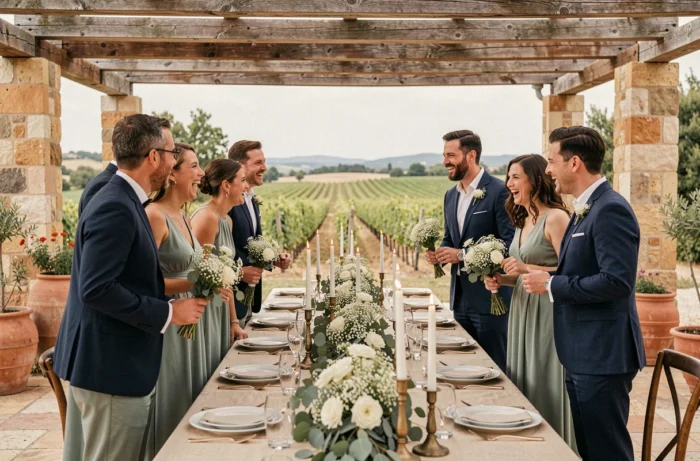
The most significant trend this year is the wedding spread over several days. Welcome evening the night before, ceremony and dinner on the big day, brunch the next day. This format radically alters the requirements for the venue.
A domain or a castle capable of accommodating some guests on-site avoids the hassle of shuttles, scattered hotels, and curfews imposed by certain municipal halls. Feedback varies on this point, but couples who have tried the “weekend” format consistently mention a gain in conviviality and a more relaxed atmosphere right from the cocktail hour.
The trap is the hidden extra costs. Renting a venue for two nights instead of one evening rarely doubles the price, but you must add breakfast, Sunday brunch, additional cleaning, and sometimes a higher deposit. Before signing, ask for a comprehensive “weekend package” quote rather than negotiating each service separately.
Outdoor Ceremony: Anticipate the Weather Without a Wobbly Backup Plan
Organizing an outdoor ceremony has become standard. The weather risk remains the weak point. Planning a backup structure that can be set up in two hours (stretch tent, clear marquee) costs a few hundred euros to rent but can save the day. Relying on “it won’t rain” is not a plan.
Decoration and Wedding Trends: Focus on Cohesion Rather Than Accumulation
Color palettes evolve each season, and inspirations circulate quickly. In 2026, there is a return to muted tones (terracotta, sage green, rosy beige) and raw materials (wrinkled linen, untreated wood, artisanal ceramics). What makes the difference is not the chosen color, but the rigor with which it is applied.
A visually successful wedding often hinges on three decisions:
- A palette limited to two or three shades, reflected in the invitations, table stationery, napkins, and flowers
- A recurring signature element (a floral pattern, a type of candle, a typography) that creates a thread from the entrance of the venue to the dessert
- The abandonment of “default” elements that correspond to nothing (white chair covers, organza bows) in favor of a bare table if the furniture is beautiful
Visual coherence costs less than accumulation. Renting matching vintage furniture often costs less than decorating standard furniture with miles of fabric.
Wedding Organization: The Providers to Secure First
The order in which providers are booked has a direct impact on the stress of the final months. Couples who finalize their preparations calmly generally share the same sequence.
- The venue, twelve to eighteen months in advance: this is the category most constrained by availability, especially for Saturdays from June to September
- The caterer, immediately after securing the venue, because some domains require a designated provider or a limited list
- The photographer and the DJ or band, eight to ten months in advance: good profiles are booked very early
- The florist and stationery, six months in advance, once the color palette is finalized
The wedding planner ideally gets involved from the start, but their usefulness is maximized for couples organizing a wedding over several days or in an atypical venue (farm, vineyard, private property without infrastructure). For a classic wedding in a hall with an integrated caterer, a day-of coordinator may suffice.
Guests: Managing the List Without Family Conflict
The size of the guest list determines the budget, the venue, and the atmosphere. The trend towards intimate weddings is confirmed, but “small” does not mean the same thing for everyone. Setting a maximum number before starting the list (and not the other way around) avoids endless negotiations. A cap on guests set from the start simplifies every subsequent decision.
This year’s weddings show that couples who stand by their choices, whether on format, budget, or guest list, achieve a more coherent and relaxed celebration than those who try to satisfy all expectations. The best advice remains the simplest: decide together what truly matters, and stick to that line until the big day.