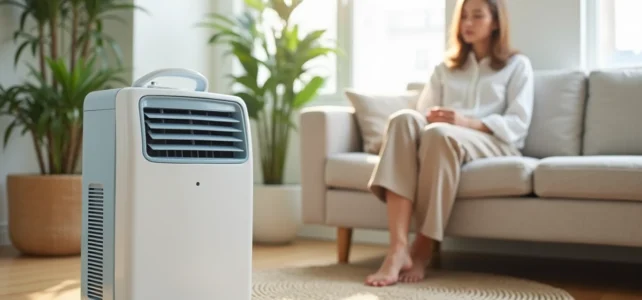
An air cooler works by evaporation: a fan blows air through a wet pad, which lowers the perceived temperature by a few degrees without using a refrigerant gas. The OneConcept Carribean Blue applies this principle with a four-liter tank, a power of 70 W, and three fan speeds. On paper, the positioning is clear: to offer an alternative to portable air conditioners for a reduced budget.
Physical Limit of Evaporative Cooling and Consequences on Comfort
Evaporative cooling relies on a simple thermodynamic exchange. Water transitions from a liquid state to a gaseous state by absorbing energy from the surrounding air, which lowers its temperature. The efficiency of this transfer directly depends on the humidity level of the room.
Related reading : Discover the fortune and background of Roger Erhart: career and salary revealed
In an already humid environment, the air can no longer absorb much additional vapor. Cooling quickly reaches a plateau. Tests by Que Choisir show that most coolers only achieve about -2 °C in 26 minutes in the lab, and -3 °C remains out of reach for many devices.
The Carribean Blue is not exempt from this constraint. During prolonged heat waves, when humidity rises, the device produces a flow of warm, humid air. Comfort deteriorates instead of improving.
Recommended read : Denzel Washington: height, weight, private life, and secrets of the Hollywood actor

60 Millions de consommateurs reminds us that water coolers cause an increase in ambient humidity, sometimes making the heat feel heavier despite the measured drop in temperature. In a small attic room, a common use case for this type of device, the risk of a stifling room at night increases if ventilation remains insufficient. Regular airing becomes a necessity, not just a simple recommendation.
To consult a detailed review of the OneConcept Carribean Blue air cooler with ratings by criteria, the specialized site rafraichisseurdair.com offers a complete sheet of the device.
Tank, Ice Packs, and Airflow of the OneConcept Carribean Blue
The removable four-liter tank is filled from the back of the device. Two cooling containers are supplied with the cooler. The principle: place these ice packs in the freezer, then put them in the tray before starting the fan. The water stays cold longer, extending the effective cooling period.
In practice, the autonomy of the ice packs does not exceed one to two hours depending on the ambient temperature. They then need to be returned to the freezer and waited for several hours before reuse. Having two sets of ice packs in rotation helps avoid interruptions, but the cooler only comes with two.
The advertised airflow reaches 400 m³/h, a decent figure for a device in this range. Three speeds allow for flow adjustment:
- Speed 1: discreet airflow, suitable for an office or nighttime use if the noise remains bearable
- Speed 2: a compromise between air circulation and noise level, sufficient for a medium-sized room
- Speed 3: maximum airflow, but the noise becomes noticeable and may be disruptive in a bedroom
The “Cool” button activates the water pump that moistens the evaporation pad. Without this function, the device operates as a simple fan. The ventilation mode alone does not cool the air, it circulates it.
Noise Level and Night Use: The Recurring Weak Point
Several user feedback reports a bothersome noise level at full power. Air coolers in this price category regularly exceed 60 dB(A) according to Que Choisir, a threshold too high for comfortable sleep.
The Carribean Blue is no exception. At speed 3, the noise from the fan combined with that of the water pump creates a noticeable nuisance. At speed 1, the device remains more discreet, but the reduced airflow limits the feeling of coolness.
Using the cooler during the day and turning it off at night seems to be the most realistic compromise for many users. Those seeking a silent device for a bedroom will need to look for a model with a minimum noise level significantly below 50 dB(A).
Power Consumption and Value for Money Compared to an Air Conditioner
With a power of 70 W, the Carribean Blue consumes a fraction of what a portable air conditioner requires (often between 800 and 1,500 W). Over a full summer season, the difference on the electricity bill is significant.
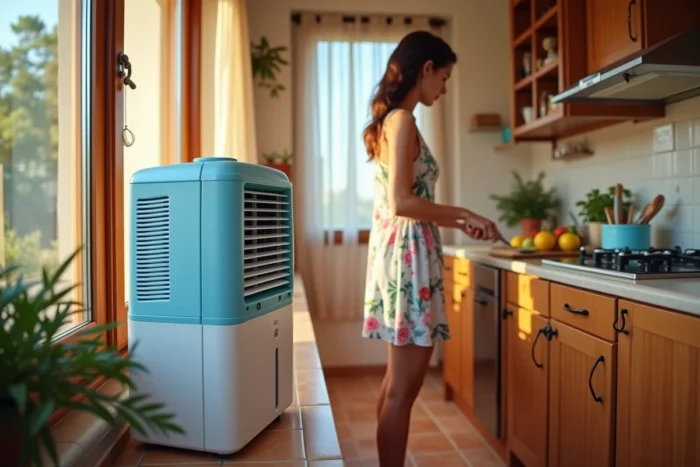
The purchase price positions this model as one of the cheapest coolers on the market. The question of value for money then arises in terms of realism:
- For a well-ventilated room with moderate humidity, the Carribean Blue offers a valuable comfort supplement for minimal cost
- For a closed, humid room or during a heatwave, the performance gap with an air conditioner remains considerable
- Maintenance is limited to cleaning the tray and periodically replacing the evaporation pad, keeping the operating cost very low
The provided wheels and side handles make it easy to move from room to room. The lightweight design of the device enhances this mobility, a concrete advantage over portable air conditioners that often weigh three to four times more.
The OneConcept Carribean Blue fulfills its function in a specific context: to slightly cool an airy room with low humidity for a limited budget. Expecting this device to replace air conditioning during prolonged heat waves leads to disappointment. The difference between a cooler and an air conditioner is not a matter of range; it is a difference in physical principle.