
Size S does not correspond to a single measurement. Depending on the type of clothing, the brand, and the country of manufacture, the actual dimensions behind this letter vary by several centimeters. To know if an S fits your body shape, you need to compare specific measurement ranges, not rely on a generic equivalence.
Measurement discrepancies between tops and bottoms for size S
Most size guides present S as equivalent to French sizes 36/38. This correspondence masks a documented discrepancy between clothing categories.
Recommended read : How to Choose the Ideal Equipment for Your Modern and Comfortable Home
For women’s tops (t-shirts, sweaters, blouses), a French 36 is generally associated with an S. For men’s pants, the same French 36 corresponds more to an XS or S depending on the brands. The discrepancy exists in the official France/US/UK conversion charts, but consumer articles rarely mention it.
If you want to know which size S to choose, the first step is to distinguish the category of the clothing in question before consulting a size chart.
Further reading : How to Choose the Best Personal Loan to Finance Your Projects
| Category | French size associated with S (women) | French size associated with S (men) |
|---|---|---|
| T-shirts, polos, sweaters | 36/38 | 38/40 |
| Shirts | 36 | 37/38 |
| Pants, jeans | 36 | 38/40 |
| Dresses | 36/38 | – |
These ranges come from grids published by several brands. They illustrate a point often overlooked: an S for a top and an S for a bottom do not cover the same measurements.
Size S and fit type: why fit changes everything
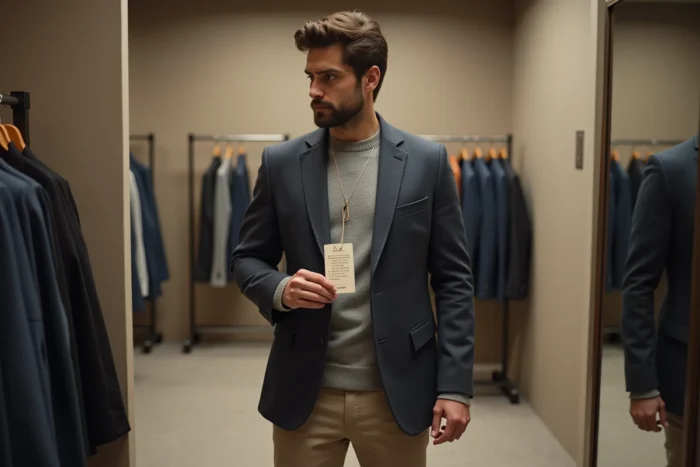
Several major brands now publish separate charts based on the type of fit. An S in a fitted style (slim fit) does not cover the same chest measurement range as an S in a standard or oversized fit.
This system makes the old equivalence “S = 36/38” increasingly unreliable for online purchases. Two t-shirts labeled S from the same brand can differ by several centimeters in chest size or length if one is relaxed fit and the other is regular fit.
The three measurements to compare for each fit
- Chest circumference: measured under the armpits, this is the main criterion for tops. Compare it to the range indicated in the brand’s guide, not to a generic grid
- Waist circumference: measured at the narrowest part of the abdomen, it determines the comfort of pants and fitted dresses. The same S can vary by two to three centimeters from one fit to another
- Inseam length: often expressed in inches for jeans. This measurement is independent of size S/M/L and should be checked separately
The current trend towards looser fits has also shifted the benchmarks. If your measurements place you between two sizes, choosing the larger size aligns more with the proportions of recent collections, where older advice recommended a closer fit to the body.
International size correspondence for S: France, US, UK
Conversions between sizing systems pose a recurring problem when shopping on foreign sites. Size S is not calibrated the same way depending on the country of origin of the garment.
| System | Women’s S equivalent | Men’s S equivalent |
|---|---|---|
| France | 36/38 | 38/40 |
| US | 4/6 | 34/36 |
| UK | 8/10 | 34/36 |
The most common pitfall concerns American brands sold in Europe. An American S tends to be roomier than a French S for the same category of clothing. Checking the size guide specific to each brand remains the only way to avoid ordering errors.
Measure rather than convert
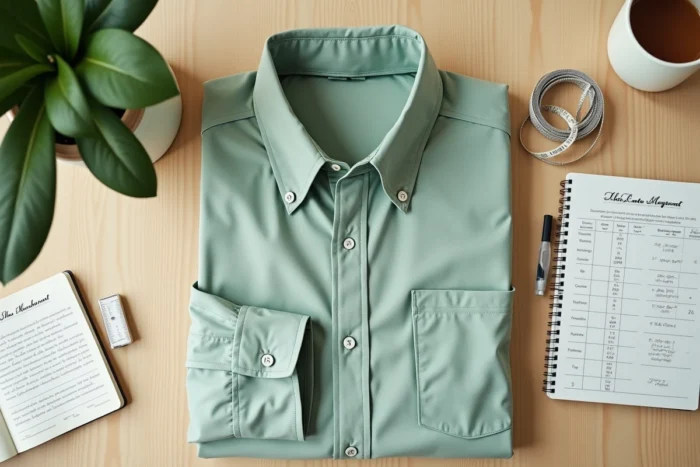
Conversion charts provide an indication, not a guarantee. The measuring tape remains the most reliable tool. Measure your chest, waist, and inseam, then directly compare these numbers to the ranges indicated by the brand in centimeters.
Take your measurements standing, without shoes, with the tape measure horizontal and flat against the skin (or over a thin undergarment). Avoid taking your measurements over a thick sweater or shirt, as the gap can skew the result by half a size.
Children’s and adolescent size S: a different logic
For children’s clothing, the letter S does not refer to the same grid as for adults. Some brands (like Nike) associate S with a specific age range, around 8-10 years for boys.
The problem: two children of the same age can have very different body shapes. The child’s height in centimeters takes precedence over age correspondence. A tall child for their age will wear an M where an average-sized child will fit comfortably in an S.
Returns of children’s clothing ordered online represent a significant portion of exchanges, precisely because the letter S gives a false impression of simplicity in a category where growth makes any standardization approximate.
S is not a size; it is a range. Its meaning changes depending on whether you are buying a top or a bottom, a slim or oversized fit, a French or American brand. Taking three measurements (chest, waist, inseam) and comparing them to the specific guide of each brand remains the safest method to avoid a return.