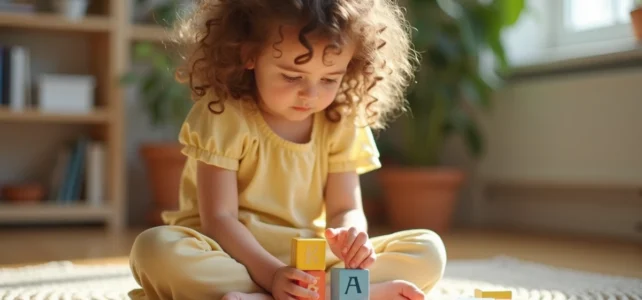
The choice of a play activity relies on a fine reading of the child’s developmental stage, not on a generic list of proposals sorted by age. We too often observe poorly calibrated materials: a sorting game offered before the ability to categorize, or a fitting puzzle kept long after the mastery of the gesture. The challenge lies in the ongoing adjustment between the playful proposition and the proximal zone of development.
Calibrating the difficulty of an educational game according to the sensorimotor profile
A toy has educational value only if it is slightly above the child’s current skills. If it is too simple, it generates disinterest. If it is too complex, it causes frustration and quick abandonment.
Read also : How to Choose the Right Size S: Essential Size Guide and Correspondences
We recommend observing three indicators before proposing a material: the spontaneous attention span on a similar task, the quality of eye-hand coordination on related gestures, and the ability to maintain a simple instruction in working memory. These three parameters allow for positioning the child on a continuum, much more reliable than an age range printed on a package.
Specifically, a child who stacks four cubes accurately but consistently fails at the fifth gains more from a vertical construction game than from a flat puzzle. The accompanying adult adjusts the material based on what they observe, not what a catalog recommends.
Read also : Discover how Optisanté's professional services support health experts
To explore ranges of toys designed with this progression logic, one can consult the child page of Ouaps, which segments its references by skill levels rather than by simple age range.
Free play versus guided activity: arbitrate according to the learning objective
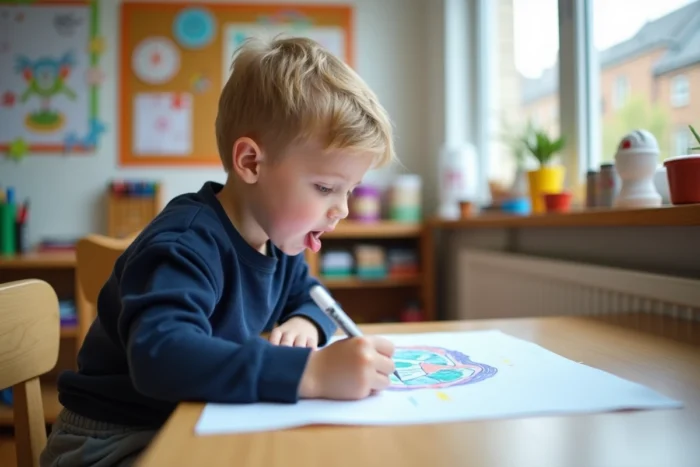
Free play and guided activity do not oppose each other; they target different skills. Free play fosters creativity, autonomous decision-making, and emotional self-regulation. Guided activity develops the ability to follow an instruction, perseverance in a structured task, and certain precise technical acquisitions (cutting, tracing, threading).
A common trap is to over-structure a young child’s day. When every time slot is occupied by a supervised activity, the child loses the opportunity to be bored, which is a powerful driver of initiative. Conversely, permanent free play without any adult proposals can leave a child going in circles, especially if they lack models for using the available materials.
The balance we recommend is based on a ratio of about two-thirds free time to one-third accompanied activity. This ratio is not rigid: it adapts to the child’s temperament and the context (community, home, outdoors).
When to intervene during free play
The adult intervenes only in three cases: to ensure safety, to reignite an exploration that is fading (by adding a new element to the environment), or to verbalize what the child is doing. This verbalization, sometimes called parallel narration, supports language development without interrupting the ongoing activity.
Adding an object to the play area (a funnel near a water tray, a fabric near figurines) often suffices to rekindle interest without turning free play into a disguised guided activity.
Nature activities and seasonality: an underutilized educational lever
Outdoor awakening activities related to the seasons bring a dimension that indoor play does not cover: direct observation of natural phenomena as a learning support. Collecting leaves in autumn, planting in spring, observing insects in summer, noting textures in winter (frost, damp bark) – each season offers free and renewed educational material.
Some concrete examples of “missions” suitable for young children:
- Finding three natural elements of different colors within a defined perimeter, then sorting them on a surface (cardboard, plate), which works on categorization and fine motor skills simultaneously
- Watering plants while measuring water with handmade graduated containers (cut bottles with markers), which introduces concepts of quantity and patience with living things
- Using a plant or bird recognition app in tandem with the adult, to bridge real exploration and digital tools, without the screen becoming the center of the activity
This last point deserves particular attention. Educational technology used as an extension of a real experience (identifying an observed bird, naming a picked plant) does not have the same impact as a screen proposed as an autonomous activity. The sequence of observation-identification-verbalization anchors learning in the concrete.
Everyday gestures as a support for awakening: going beyond formal play
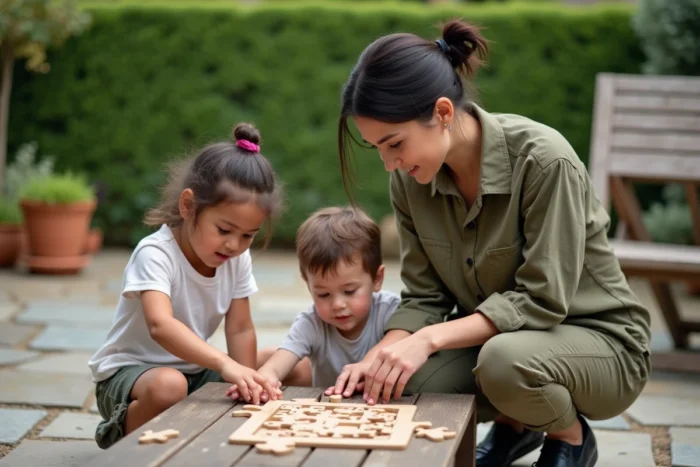
Preparing the material for an activity, choosing clothes, participating in tidying up, watering a plant: these everyday gestures constitute full learning situations. They mobilize fine motor skills, sequential planning, and understanding of cause-and-effect relationships.
Involving the child in concrete tasks develops their autonomy more effectively than a dedicated workshop. A child pouring water from a pitcher into a glass works on coordination, control of the gesture, and quantity management, exactly the same skills as a Montessori pouring exercise, but in a functional context that gives meaning to the action.
The key lies in adapting the material: a pitcher of the right size, a broom at child height, accessible containers. Without this material adjustment, the child fails due to ergonomic constraints rather than lack of skill, which completely distorts the reading of their abilities.
Criteria for transforming a daily task into a learning situation
- The task must have a visible and immediate result (the plant is watered, the table is set), which nurtures the feeling of competence
- The child must be able to complete at least one step alone, even if the adult completes the rest
- The time taken to complete the task must not exceed the child’s attention capacity for this type of task, lest it turn a rewarding moment into a source of tension
Awakening is not limited to toys or formal activities. A well-thought-out environment, adjusted materials, and an adult attentive to the child’s signals are enough to transform every moment of daily life into a learning opportunity. The best indicator remains the child’s spontaneous engagement: if they return to the activity on their own, the calibration is right.