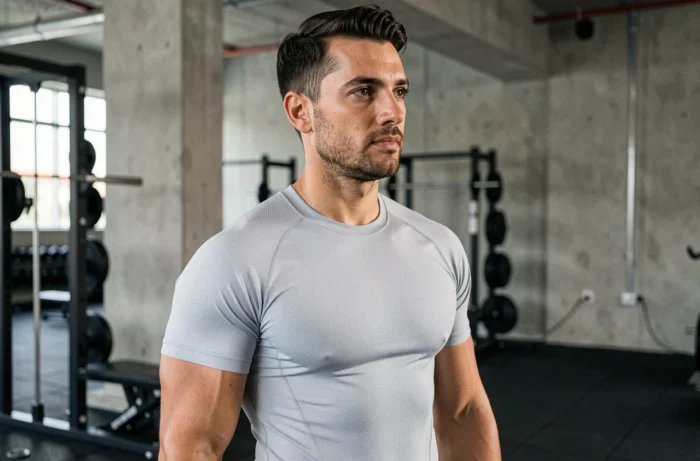
The Percko t-shirt is based on a system of tensors integrated into the fabric that exerts mechanical traction on the shoulders and upper back. The principle: to engage proprioception to encourage the wearer to correct their posture, without immobilizing the spine. This functionality distinguishes it from a simple compression garment, and it is precisely on this promise that opinions crystallize, whether enthusiastic or reserved.
Patented tensors and medical device status: what the fabric actually does
The Percko t-shirt does not act like a rigid lumbar belt. The tensors woven into the back and shoulders create an elastic resistance that reminds the wearer of an upright posture without blocking movement. The sensation is often described as “guidance” rather than constraint.
A point rarely addressed in public comparisons concerns the regulatory status of the product. The Percko sports t-shirt is now presented as a certified medical device, supported by six clinical studies involving over 4,400 people. This label implies a European compliance framework and stricter manufacturing oversight than a standard textile garment.
The nuance deserves to be made: the clinical data put forward by Percko comes from internal self-reported surveys conducted with users, not from independent randomized trials published in scientific journals. In practice, users report subjective relief (less tension, better postural awareness), but no external evidence confirms a lasting and measurable reduction in back pain.
The user reviews of the Percko Decathlon t-shirt reflect this duality between immediate positive feeling and questioning about long-term effects.

User feedback on Percko: felt effect versus objective result
Testimonials published on certified review platforms paint a fairly consistent profile. The majority of buyers note a noticeable effect from the first uses: the back “straightens,” the shoulders reposition naturally, and muscle fatigue at the end of the day decreases.
Several users clearly distinguish the Sport model from the everyday model. The Sport model, more fitted, offers more pronounced support and can be easily worn under work clothes or during physical activity. The everyday model functions more like a “second skin,” with a more discreet postural reminder.
- Initial comfort is the most frequently praised point: the fabric is forgotten after a few minutes, unlike rigid back supports that irritate or compress.
- The “wow” effect of the first days tends to normalize after a few weeks, leading some users to doubt the product’s prolonged effectiveness.
- The sizing is divisive: several buyers recommend taking a size down to increase the postural reminder, while others find the product already sufficiently fitted to the recommended size.
- The price remains the main barrier mentioned in negative reviews, as the Percko t-shirt is significantly more expensive than a standard technical garment sold in sports stores.
Percko and Decathlon: two distinct distribution logics
Associating Percko and Decathlon in the same search reflects a specific expectation: to find this product in an accessible distribution network and to physically test it before purchase. The reality on the ground is more nuanced.
Percko primarily distributes through its own e-commerce site and a few selected partners. The Percko t-shirt is not a product from the Decathlon range, and the two brands do not have an integrated distribution partnership. Confusion often arises from comparisons between the Percko t-shirt and postural or compression garments sold at Decathlon at much lower prices.
This price difference is explained by the patent on the tensor system, the “medical device” positioning, and the dedicated after-sales service (thirty-day trial, size exchange). Decathlon products of the postural support type use classic compression approaches, without the patented proprioceptive reminder mechanism.

Complementarity with medical follow-up: what osteopaths observe
Osteopaths who have tested the Percko t-shirt emphasize a point rarely highlighted by the brand itself: the product does not correct a pathology, it supports postural rehabilitation. The fabric helps maintain the corrections made during osteopathy or physiotherapy sessions, but it does not replace a diagnosis or treatment.
The physiological action of the t-shirt focuses on proprioception, not on muscle strengthening. A wearer who does not engage in any core strengthening or stretching exercises will revert to their bad habits as soon as they remove the garment. Health professionals therefore recommend using it as a complementary tool, within a broader approach.
Use cases where the t-shirt shows its limits
For individuals suffering from structural pathologies (herniated disc, pronounced scoliosis, narrow lumbar canal), the Percko t-shirt does not provide sufficient relief. Its mechanical action remains superficial compared to the stresses placed on the spine in these cases.
Sedentary users who spend more than eight hours sitting report a real benefit in terms of cervical and back fatigue. However, for physical jobs involving heavy lifting, the Lyne Pro model, designed for handling, proves more suitable than the general public model.
The Percko t-shirt meets a real need for daily postural reminder, and most users confirm this effect. The lack of independent studies remains the weak link in the case, and it is a criterion to keep in mind before considering this product as a complete medical solution.