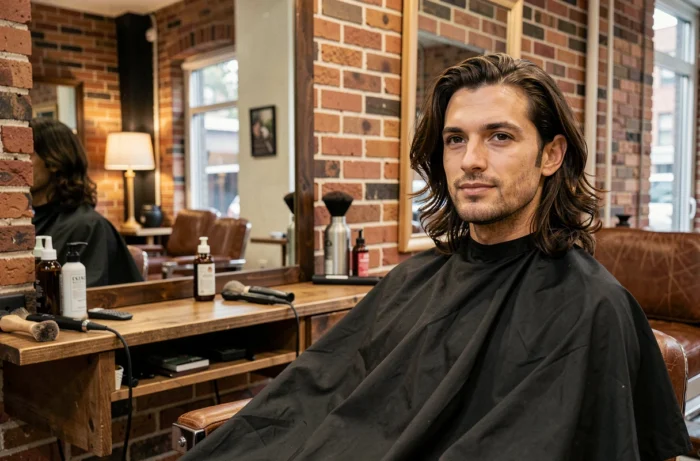
A man with fine hair on the top of his head who wants to switch to a textured mid-length cut quickly hits a wall: there’s a lack of substance, and no styling product can create volume from nothing. This is precisely the use case where hair extensions for men make a difference.
Long associated with women, the application of hair extensions now concerns a male audience seeking volume, length, or a different look without waiting months for regrowth.
Traction Alopecia in Men: The Risk That Salons Rarely Mention
Before discussing methods or styles, we must address a topic that most guides gloss over. The repeated traction exerted by extensions, especially if they are heavy or placed too close to the scalp, can trigger traction alopecia that is initially reversible, then permanent.
Recent dermatological sources emphasize a window of reversibility: if the tension is stopped early, regrowth remains possible. However, when the scalp takes on a smooth and shiny appearance, we transition into scarring alopecia, and at that point, no topical treatment can rectify the situation.
In practical terms, this means three things for a man wearing extensions:
- Reduce the weight and length of the added strands to the strict minimum, not to the maximum that the stylist proposes.
- Plan breaks between each application (a minimum of several weeks) to allow the follicles to recover.
- Monitor areas of tension, particularly the hairline and temples, which are more vulnerable in men already prone to androgenetic thinning.
This risk is amplified on hair already weakened by chemical treatments (bleaching, straightening). One may want to know everything about hair extensions for men before diving in, but the first question to ask the stylist remains about the actual condition of the scalp, not about the color of the strands.

Keratine, Rings, or Clips: Which Method for a Men’s Cut
The choice of technique depends less on current trends than on the starting length and the area to be covered. A man with a few centimeters on top wanting a mid-length look does not have the same options as another who is just looking for volume on an already textured cut.
Keratine Application (Hot)
This is the most common method in salons for men. The strand is secured with a keratin glue point a few millimeters from the scalp. For the attachment points to remain invisible, a minimum of natural length is required: about five centimeters at the nape and more on the top of the head.
The result lasts several months. The downside: removal requires a salon visit, and the tension on the follicle is constant throughout the duration of the application.
Rings (Micro-ring)
No heat, no glue. The strand is held by a small ring tightened with pliers. The removal is simpler, and natural hair undergoes less thermal stress. Feedback varies on the longevity, especially on short and fine hair where the ring may slip.
Removable Clips
The most flexible option to test a look without commitment. Clip in the morning, take out in the evening. No risk of prolonged traction since the scalp is freed daily. The result is less discreet at the root, and this method is better suited for adding temporary volume than for a lasting transformation.
Texture and Color: Achieving a Natural Look on a Men’s Cut
The difference between visible extensions and a convincing result lies in two parameters that many overlook.
The first is the texture of the added strands compared to natural hair. Smooth extensions on naturally wavy hair create an immediate break. Strands made from European natural hair generally offer better mimicry than synthetic fibers, but their cost is significantly higher.
The second parameter is color matching. On a short to mid-length cut, even the slightest shade discrepancy is noticeable, especially in natural light. A good stylist adjusts the shade of the extensions after application, not before. If the salon only offers a standard color chart without personalized adjustments, that’s a red flag.
Maintenance of Extensions for Men: What Changes Daily
Wearing extensions alters the hair care routine, and this is where many men become disillusioned after a few weeks.
- Washing should be done with sulfate-free products to preserve the attachment points (keratin or rings).
- High-temperature drying should be limited. A dryer with moderate heat or air drying protects both the extensions and natural hair.
- Contact sports or swimming in chlorinated pools accelerate the degradation of the attachments. Plan for a cap or rinse thoroughly after each session.
- Brushing should be done from the tip to the root, without pulling, using a soft-bristle brush.
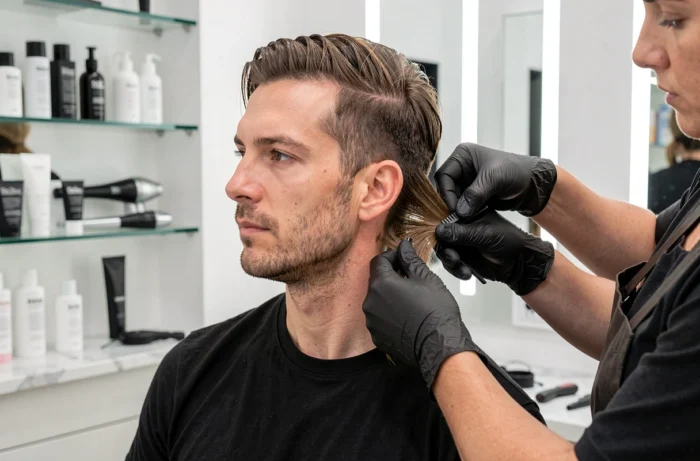
Regular maintenance in the salon, every few weeks, remains necessary to check the condition of the attachments and reposition strands that may have migrated with natural regrowth.
The overall cost of applying hair extensions for men far exceeds the initial price: one must factor in touch-ups, specific products, and professional removal. It’s better to ask for a complete quote including follow-up before committing, rather than just comparing the prices of the initial application.
Hair extensions for men allow for a quick change of look, provided the limits imposed by the scalp are respected. The choice of method, the weight of the strands, and the frequency of breaks between applications protect hair density in the long term. A stylist who takes the time to assess the condition of the hair before proposing a technique is worth much more than a salon that promises spectacular results in a single session.