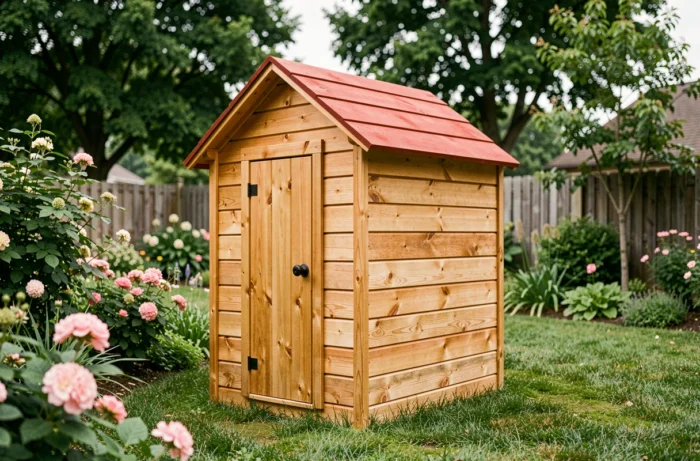
When installing a children’s playhouse in the garden, the first issue is not the model, but the ground. A sloping terrain, a lawn that becomes waterlogged in autumn, or a space too close to the neighbor’s fence radically change the list of feasible playhouses. Before browsing the playhouse aisle, it’s better to take out the measuring tape and check what the ground really allows.
Ground, slope, and drainage: what determines the choice of a children’s playhouse
A playhouse placed directly on damp soil will warp within a few seasons, even with pressure-treated wood. So, we start by identifying the nature of the soil. On clayey ground that retains water, it’s necessary to plan for a bed of compacted gravel or stabilizing slabs under the structure.
The slope also matters. Beyond a slight incline, a raised playhouse becomes more relevant than a flat model, because the difference in height can be compensated with the legs of the structure. Elevated models sold in DIY stores often include adjustable supports, but it’s important to check the adjustment range before purchase.
To find the ideal Brico Dépôt children’s playhouse, it’s efficient to first note three pieces of information: the available ground area (counting a safety perimeter of at least one meter around the playhouse), the exposure to the prevailing wind, and the proximity to a water source or a tree whose roots could lift the base.
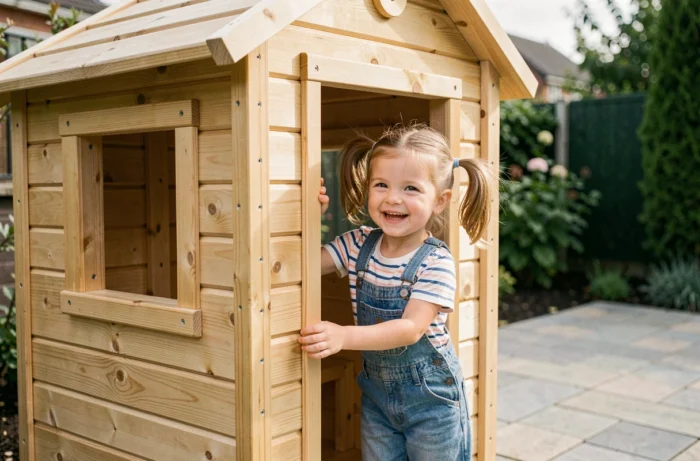
Raised playhouse or ground-level playhouse: safety constraints and EN 747 standard
Raised playhouses are more appealing to children, but they raise a regulatory question that few parents anticipate. The European standard EN 747, tightened since 2024, now applies not only to bunk beds. It now also applies to elevated playhouses presented as decorative, even when sold as play elements.
Specifically, decree no. 95-949 of August 25, 1995, considers a sleeping area to be elevated as soon as the top of the mattress base is 60 cm or more off the ground. The mention “the elevated sleeping area is not suitable for children under six years” must appear on the product, packaging, and instructions.
For a garden playhouse on stilts that does not include a sleeping area, this standard does not apply directly. The boundary becomes blurred when a mattress or a bed is added to the elevated playhouse. If your children sleep in the playhouse, the guardrail and labeling requirements apply, even for occasional use.
CE marking and mechanical resistance
Playhouses sold as outdoor toys by major manufacturers (Soulet, Smoby, and models distributed in DIY stores) are designed with a CE marking. This implies testing for mechanical resistance, stability, and the absence of hazardous substances in paints or wood treatments.
Check for the presence of this marking on the packaging. A handmade playhouse or a kit sold by a third-party seller on a marketplace does not always offer this guarantee.
Pressure-treated wood or raw wood: real maintenance over several seasons
The choice of material often boils down to two options in the DIY store: pressure-treated wood (usually Scots pine) and raw wood that needs to be treated oneself. Pressure-treated wood is more resistant to moisture without maintenance in the first year, but it can gray and crack as early as the second season if not protected.
Raw wood requires a stain or saturator before the first winter. Two coats should be applied, paying special attention to cuts and joints where water can seep in. Expect half a day’s work for a standard playhouse.
- Class 3 pressure-treated wood: suitable for ground-level playhouses, resistant to moderate weather, but requires staining every two to three years to maintain its appearance
- Raw wood (spruce, pine): cheaper to purchase, requires initial treatment and then annual maintenance, or else mold will appear
- Composite panels or recycled plastic: no maintenance required, but less warm to the touch and often limited to models for younger children
Feedback varies on the actual durability of pressure treatment depending on batches and suppliers. For a model distributed in a supermarket, inspect the knots and ends of the boards upon receipt to spot any potential treatment defects.
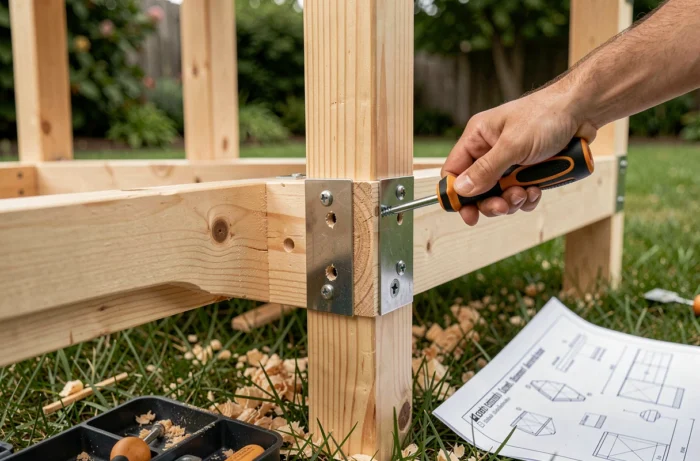
Assembling a Brico Dépôt children’s playhouse: mistakes that cost time
The instructions usually state two to four hours of assembly for two adults. In practice, the assembly time doubles if the ground is not prepared in advance. Level the area, check the squareness after each step, and tighten the screws in two passes (first by hand, then with a screwdriver once everything is aligned).
Three points to watch during assembly:
- The pre-drillings: some kits do not have them, which can cause splintering in the wood if screws are driven directly. A 3 mm drill bit before each screw avoids the problem
- The door and shutter hinges: often undersized in entry-level models. Replace them with stainless steel hinges during assembly to avoid rust
- The anchoring to the ground: a non-fixed playhouse can tip over in strong winds. Metal brackets screwed into concrete blocks or driven stakes secure the structure
Adapting the playhouse to the children’s age
For children under three, prioritize a ground-level playhouse with a wide door and no integrated slide. Plastic models like Smoby are well-suited for this age. From four or five years old, a wooden playhouse with an elevated floor offers a more stimulating play area and lasts longer.
Some models are said to be adaptable: you can add a slide, a sandbox, or a side extension over the years. Before purchasing, check that the complementary accessories are still available from the same manufacturer, as ranges change quickly from season to season.
A well-chosen playhouse can easily last a decade with regular maintenance. The distinguishing factor in use is neither the color nor the design, but the quality of the joints and the thickness of the boards. Below a certain wall thickness, the structure vibrates and creaks as soon as the children move around, which eventually poses a stability issue.