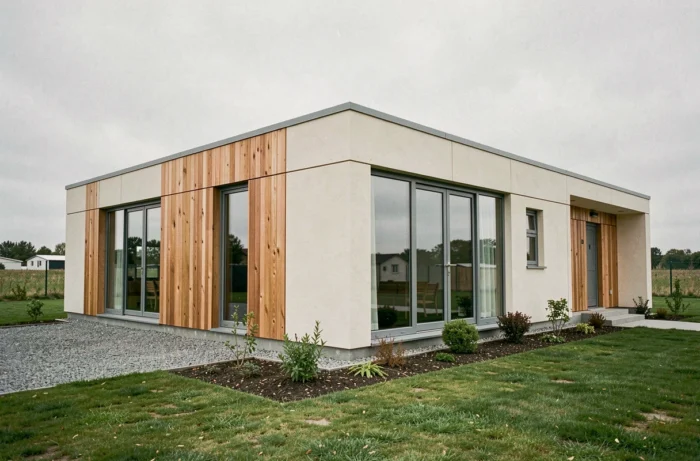
A modular home is a dwelling whose components are manufactured in a factory, then transported and assembled on a site. This off-site construction method reduces site-related uncertainties (bad weather, delays in material delivery) and allows for constant quality control at each stage of production. Purchasing a modular home involves technical, regulatory, and financial choices that are quite different from those of a traditional house.
RE2020 and permanent modular housing: a constraint often overlooked
Most commercial presentations emphasize the energy performance of modular homes without specifying the exact regulatory framework. For a modular home installed for more than two years, RE2020 applies fully, just like for any new conventional construction.
This means that the builder must comply with Bbio indicators (bioclimatic needs), Ic construction (carbon impact), and the degree-hour threshold for summer comfort. An official application sheet “Temporary Constructions,” updated on March 14, 2025, limits the adapted requirements to three specific cases: constructions of less than two years, removable school classes, and buildings related to work execution or marketing.
Before signing, ensure that the manufacturer provides a complete thermal study and compliant carbon calculation. A “turnkey” module delivered without these documents exposes the buyer to a compliance rejection during inspection and complicates resale. The offers listed on immodeule.fr allow for comparing modular projects with their detailed technical characteristics.

Ten-year warranty and damage insurance for a modular home
A permanent modular home benefits from the same legal protections as a traditional construction. The ten-year warranty covers structural defects for ten years after the completion of the work. It concerns foundations, framing, waterproofing, anything that compromises the solidity or makes the building unfit for its intended use.
Damage insurance, taken out by the project owner (you, the buyer), allows for pre-financing repairs without waiting for a court to designate the responsible party. This insurance remains mandatory even if the home is produced in a factory.
A common trap in modular construction lies in the multiplicity of stakeholders. The manufacturer of the modules, the transporter, the company that carries out the foundations, and the one that ensures the final assembly can be distinct entities. In the event of a claim, the absence of a single ten-year certificate can block compensation.
- Request the ten-year warranty certificate from each stakeholder before the start of the work, not just from the module manufacturer.
- Take out damage insurance before the site opens: its cost represents a fraction of the total budget, but its absence can delay any repairs by several years.
- Keep the signed acceptance report from all parties: this is the document that triggers the ten-year warranty count.
Price of a modular home: items that the quote does not always detail
The price displayed by a modular builder generally covers the manufacturing of the modules and their assembly. This price varies significantly depending on the material (wood, steel, recycled shipping container), the level of interior finish, and the living area.
Several items often remain outside the initial quote and can represent a significant portion of the final budget:
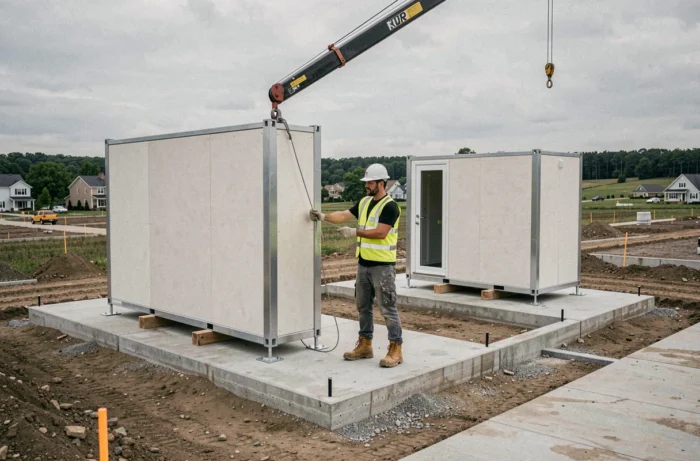
- The foundations: their type (concrete footings, slab, crawl space) depends on the soil study. A clayey or sloped site significantly increases the cost.
- The connection to networks (water, electricity, sanitation): the distance between the site and public networks determines the bill. An isolated site may require individual sanitation.
- The transport of the modules: beyond a certain distance between the factory and the site, logistical costs rise, especially for oversized modules that require special transport.
- The RE2020 thermal study and compliance check, charged separately by some manufacturers.
Comparing modular quotes therefore requires relating each offer to the overall “ready to live in” cost, including foundations and connections. An attractive price per square meter loses all meaning if half of the technical items are missing.
Land and urban planning: checks before purchasing a modular home
A permanent modular home requires a building permit, issued by the town hall. The Local Urban Planning Plan (PLU) of the municipality sets the implantation rules: footprint, maximum height, distances from property boundaries, permitted facade materials.
Some PLUs impose aesthetic constraints (mandatory coating, roof color) that may conflict with the raw appearance of a container or steel module. Check compatibility before choosing a model. The operational urban planning certificate remains the most reliable document: it indicates whether your project is feasible on the targeted plot, with available networks.
The soil study (geotechnical study G2) conditions the type of foundations. Since the Elan law, this study is mandatory in areas exposed to the shrink-swell of clays, which concerns a large part of French territory.
Bank financing for a modular home: what changes
Banks finance permanent modular homes in the same way as a conventional construction, provided that the project complies with current standards and that the land is buildable. The loan is generally structured as a construction loan with staggered drawdowns according to the progress of the work.
The difficulty arises when the manufacturer requests a high deposit before the delivery of the modules, while the bank conditions the release of funds on the progress observed on site. Negotiate a payment schedule aligned with verifiable stages: pouring of foundations, delivery of modules, assembly, connections, finishes.
The shortened construction time of modular homes (often two to three times shorter than a traditional site) reduces the duration of interim interest, which lowers the total cost of the loan. This is a concrete financial advantage that few buyers incorporate into their comparison.
The purchase of a modular home is based on the same fundamentals as any real estate acquisition: regulatory compliance, comprehensive insurance coverage, and control of the actual budget. The specificity lies in the fragmentation of stakeholders and the necessity to verify, item by item, what the quoted price really includes.