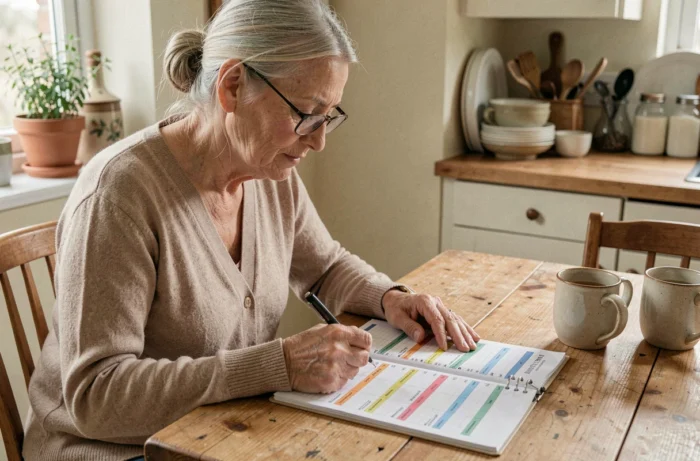
When a home caregiver visits three times a week but the elderly person can no longer remember whether the cleaning was done on Tuesday or Thursday, the problem is not memory. It is the absence of a readable schedule, accessible without effort, that reflects what has actually happened at home. Logisfil, a telemanagement tool used by many home care organizations, offers a beneficiary space that precisely fulfills this role for seniors and their loved ones.
Logisfil Schedule and Allocation of Home Care Hours
Assistance plans funded by departments do not cover everything. According to data published by DREES in September 2026, departmental social home assistance for the elderly has decreased for the first time since 2020. In practical terms, this means that each hour of the assistance plan must be used for priority tasks.
We can clearly see on the ground what this changes: when the volume of hours decreases, decisions must be made between bathing, meal preparation, and home maintenance. A telemanagement schedule like that of Logisfil allows for visualizing the time slots validated by the organization, thus verifying that the visits correspond to the priorities defined in the assistance plan.
The Logisfil schedule for beneficiaries displays timestamped interventions, providing the senior or their caregiver with a factual view of the actual distribution of visits. Without this tool, one ends up reconstructing the week from memory, with all the approximations that entails.
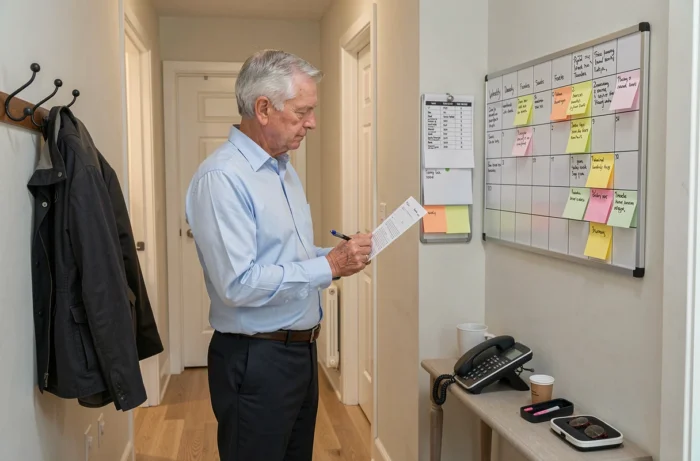
Digital Skills of Caregivers and Reliability of the Senior Schedule
A schedule is only valuable if the data that feeds it is accurate. However, the reliability of the time tracking directly depends on the digital skills of the caregivers. OPCO Santé has recently launched a digital skills transition program aimed at professionals in the medico-social sector. This program aims to enhance the digital autonomy of field teams, including on telemanagement tools.
When a home caregiver forgets to clock in or badges in late, the beneficiary’s schedule shows a shifted or even missing time slot. The senior consulting their Logisfil space then sees a “gap” that does not correspond to reality. This discrepancy generates concern, especially for family caregivers who monitor interventions from afar.
The upskilling of caregivers on mobile time tracking reduces these gaps. Feedback on this point varies among organizations, but those that systematically train their teams on badging notice fewer manual corrections afterward.
Logisfil Beneficiary Space: What a Senior Can Check Alone
The beneficiary space is not a complex dashboard. It displays validated visits with the date, time, and type of intervention. For a senior living alone, this traceability replaces the paper communication book that no one really filled out.
Here’s what can be concretely checked from the beneficiary space:
- The actual times of each visit, compared to the scheduled time slots in the assistance plan
- The type of service recorded (meal assistance, bathing, maintenance) to ensure that priority tasks are indeed covered
- The history of interventions over several weeks, useful during a renewal of the assistance plan or a discussion with the department
This autonomous verification is an underestimated lever of autonomy. The senior remains an active participant in their support instead of being subjected to a schedule decided without them. Family caregivers, when access is delegated to them, can also monitor the regularity of visits without having to call the organization every week.

Coordination Between Family Caregivers and Telemanagement Schedule
The barometer from the Escale des aidants has highlighted that the majority of family caregivers still manage coordination with organizations by phone or informal messages. The Logisfil schedule does not replace this communication, but it provides a shared factual basis.
Let’s take a common case: a son who lives several hundred kilometers away checks every Sunday that the four weekly visits have indeed taken place. Without a digital tool, he must call his mother, who does not always remember the exact days, and then possibly contact the organization. With access to the beneficiary space, the verification takes just a few minutes and does not depend on any intermediary.
This autonomy of consultation also changes the relationship with the service provider. When a caregiver contacts the manager with a specific question (“the Thursday morning visit does not appear”), the response is quicker than for a vague request (“we don’t know if someone visited this week”).
Limitations to Keep in Mind
The schedule only shows timestamped visits. It says nothing about the quality of the intervention or the state of the person. A recorded time slot does not guarantee that the meal was adapted to nutritional needs or that the bathing went well. Telemanagement tracks presence, not care.
Moreover, resetting the password must go through the organization’s manager. In case of lost credentials, the senior cannot recover their access alone, creating a temporary dependency on the service provider.
Organizing the daily life of a senior at home relies on concrete tools that make visible what is actually happening within the walls of the home. The Logisfil schedule does not solve everything, but it lays a verifiable foundation on which the senior, their loved ones, and the organization can rely to adjust priorities week after week.