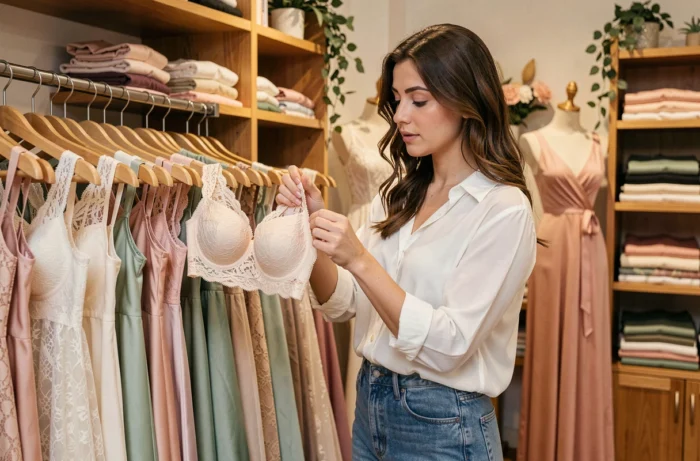
The women’s lingerie market is undergoing a period of accelerated transformation. Between the strengthening of the European regulatory framework on eco-design, the evolution of comfort expectations, and the emergence of new aesthetic codes, the usual benchmarks are shifting. Understanding these transformations helps make more informed choices, whether buying for everyday use or for special occasions.
European Regulation and Lingerie: What the ESPR Regulation Changes
The regulation (EU) 2024/1781 on the eco-design of sustainable products (ESPR), which came into effect on July 18, 2024, extends its requirements to almost all physical goods, including textiles. Lingerie is directly affected.
Specifically, brands will need to progressively design their products according to criteria of sustainability, reparability, recyclability, and recycled content. A specific delegated act for the textile sector is planned between 2025 and 2027, with clothing and linen classified as a priority sector in the ESPR work plan 2025-2027.
For lingerie, the composition of fibers, the percentage of recycled content, concerning substances, and end-of-life become regulatory parameters, not just marketing arguments. The upcoming requirement for a digital product passport will enhance this traceability: each piece must display its lifecycle in a readable manner.
Field reports differ on the adaptation pace of small artisanal brands to these obligations. Large retailers have started to anticipate, but independent designers have fewer resources to comply with the new standards. A wide range of models and collections can be explored on https://www.lingeriefeminine.be/, allowing comparisons of approaches by brand.
Choosing a Bra Suitable for Your Bust: Often Ignored Technical Criteria
Size is not just a number and a letter. A poorly fitting bra compresses breast tissue, digs into shoulders, or rides up in the back. This problem is common: many women wear an unsuitable size without realizing it.
Three checkpoints help assess a correct fit:
- The band (the band under the bust) should remain horizontal in the back, without riding up. If it rides up, the band size is too large.
- The center gore (the small piece between the two cups) should be flush against the sternum. If it floats, the cup is too small or the shape is unsuitable for the body type.
- Straps provide less support than one might think. The main support comes from the band, not the straps. If they dig into the shoulders, it is often a sign of a band that is too loose, shifting the weight upward.
Wire-free styles have gained ground in recent years. They are well-suited for small to medium busts and everyday use. However, for generous busts, underwired or full-coverage cup styles often remain more suitable for long-term support.
Fabrics and Everyday Comfort: Cotton, Microfiber, Lace
The choice of material directly influences the comfort of wear, the durability of the garment, and its care. Three families of textiles dominate the women’s lingerie market.
Cotton, breathable and soft, remains the most common choice for everyday panties. Its absorbency makes it an ally in all seasons. It withstands repeated washes well, provided that excessively high temperatures are avoided, which can deform the elastics.
Synthetic microfibers (polyamide, fine polyester) offer a smooth touch and great stretchability. They dry quickly and are barely noticeable under fitted clothing. Their limitation: they retain odors more than natural fibers and require regular washing at low temperatures.
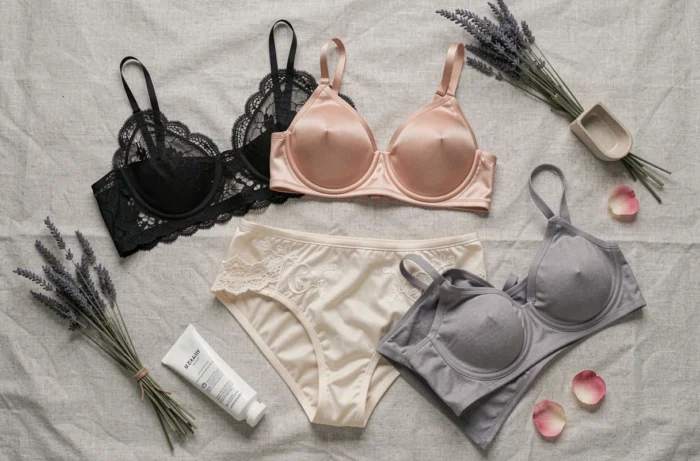
Lace, often associated with seduction, is also available in comfortable stretch versions for regular use. Modern laces, knitted rather than embroidered, conform better to the silhouette without scratching. Quality varies significantly across ranges: cheap lace frays after a few washes, while quality lace retains its elasticity and appearance.

Trends in Women’s Lingerie: What is Worn and What Lasts
Current trends revolve around a few axes. Visible lingerie, worn as a style element in its own right, has firmly established itself. Bralettes under an open blazer, bodysuits as tops: the line between underwear and clothing is blurring.
Colors are evolving too. Black and nude remain safe bets, but saturated shades (deep burgundy, midnight blue, forest green) are gaining ground in collections. Red, associated with classic seduction, maintains its place in event lines.
The most structuring trend is not aesthetic; it is functional. Comfort has become a non-negotiable criterion, even for pieces intended to be seductive. Wireless bralettes, high-waisted panties, and fine microfiber thongs illustrate this convergence between well-being and style.
What is Sustainable and What is Temporary
Basic pieces in good quality cotton or microfiber transcend seasons. Investing in a few well-fitted bras and comfortable everyday panties covers the majority of needs.
Trendy pieces (sculptural lace, lace-up designs, graphic prints) complement an intimate wardrobe without replacing it. Three to four trendy pieces are enough to refresh a drawer without overconsumption, especially if chosen in materials that stand the test of time.
The European regulatory framework will gradually make the actual quality of products more transparent. In a few years, the digital product passport will allow verification of the composition, origin, and recyclability of a bra or panty before purchase. This transparency, still in its infancy, should change choice habits well beyond mere style considerations.