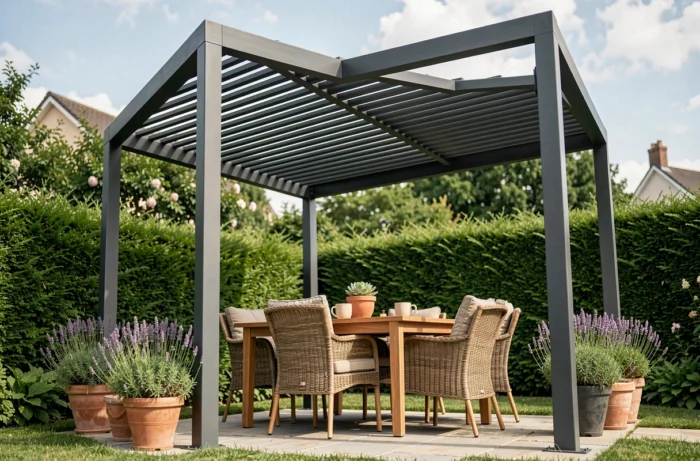
An aluminum pergola 4×3 covers an area of 12 m², equivalent to a small living room. This format, among the most requested for residential terraces, comes in several technical configurations, each with varying price ranges and performance that deserve to be measured. Fixed roof, retractable fabric, or bioclimatic adjustable slats: the three main types of coverings do not meet the same usage, budget, and regulatory constraints.
Aluminum pergola 4×3: comparison of the three types of covering
The choice of roof type determines both the comfort under the pergola, the overall budget, and the administrative procedures to be anticipated. The table below summarizes the differences between the three most common configurations in 4×3 format.
| Criterion | Fixed roof (polycarbonate or aluminum panels) | Retractable fabric | Bioclimatic adjustable slats |
|---|---|---|---|
| Light management | No modulation | Manual or motorized opening/closing | Progressive slat orientation |
| Rain protection | Total | Partial (depending on the tension of the fabric) | Total when closed |
| Natural ventilation | Low (air trapped under the roof) | Good when the fabric is retracted | Adjustable by slat inclination |
| Maintenance | Annual cleaning | Fabric replacement every few years | Cleaning of slats and integrated gutters |
| Indicative price range | Entry-level | Mid-range | High segment (Gustave Rideau, for example, lists €11,864 including tax delivered and installed for a bioclimatic model 4×3) |
Retractable fabric pergolas remain the most common compromise for mid-range budgets. They offer simple shading modulation, but their durability directly depends on the fabric’s weight and its UV resistance.
In contrast, bioclimatic models with adjustable slats stand out for their fine management of ventilation and brightness. Their higher cost is explained by the motorization, the gutters integrated into the posts, and the complexity of the structure.
Choosing a 4×3 aluminum pergola from Brico Dépôt allows access to this format without necessarily aiming for the high-end bioclimatic segment, with models featuring fixed or retractable roofs suitable for tighter budgets.
Prior declaration and property tax: what a fixed 4×3 pergola entails
A fixed aluminum pergola 4×3 represents 12 m² of ground area, well above the threshold of 5 m² that triggers the obligation for a prior declaration of work to the town hall. Ignoring this formality exposes one to a fine of up to €300,000 in the most serious cases, according to the provisions of the Urban Planning Code.
The local urban plan (PLU) of your municipality may impose additional constraints: color of the posts, distance from property boundaries, appearance of materials in protected areas. The bioclimatic PLU of Paris, which came into effect at the end of 2024, adds, for example, reinforced rules regarding the appearance of facades and vegetation for bioclimatic pergolas, with specific constraints depending on the area.
Impact on property tax
A fixed pergola attached to the house can be reclassified as covered area by the tax administration. If the structure creates an enclosed or semi-enclosed space (addition of side walls, permanent vertical blinds), it can increase the cadastral rental value and thus the property tax.
Freestanding pergolas without side closures pose fewer problems in this regard. The distinction relies on the removable or permanent nature of the structure and the presence or absence of closures.
Attached or freestanding pergola in 4×3: technical choice criteria
The choice between an attached pergola and a freestanding model is not solely aesthetic. It involves very different structural and usage constraints.
- The attached pergola anchors to the load-bearing wall of the house, which reduces the number of posts on the ground (two instead of four) and facilitates waterproofing at the wall-roof junction. However, it requires a sufficiently strong wall and may pose humidity problems if the joint is poorly executed.
- The freestanding pergola rests on four independent posts. It can be installed anywhere in the garden, away from the house, making it an option to create a separate living space, such as a dining area or outdoor lounge.
- In terms of wind resistance, the attached version benefits from the support of the building. The freestanding version requires deeper foundations (concrete footings or bolted plates) to compensate for the lack of natural bracing.
For a 4×3 format, the freestanding configuration offers placement freedom in the garden, but the foundations must be sized according to the wind exposure of the site.
Powder-coated aluminum finishes: durability and color trends
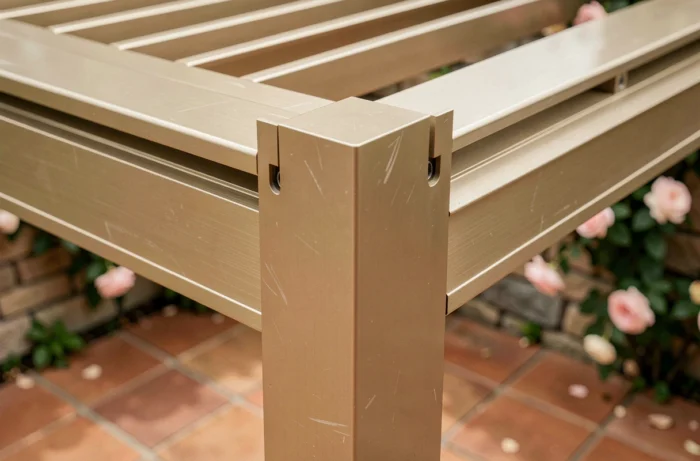
Powder-coated aluminum is the standard finish for residential pergolas. The process involves applying a polyester resin powder to the profile and then baking it to achieve a uniform protective film. This layer is resistant to UV rays, corrosion, and light impacts without requiring annual treatment.
Since 2025, manufacturers and specifiers have reported a clear increase in so-called earthy shades: terracotta, sand, warm gray. These colors align with a trend that treats the pergola as an outdoor living space, seeking harmony between the aluminum structure, garden furniture, and flooring.
Anthracite gray remains the best-selling color, but warm shades help soften the industrial appearance of raw aluminum and better integrate the pergola into a vegetated environment.
Regular maintenance of a powder-coated structure
A wash with soapy water once or twice a year is sufficient to maintain the shine of the finish. Abrasive products or pressure washers should be avoided: they can scratch or peel the lacquer layer. On bioclimatic models, the gutters integrated into the posts require seasonal checks to prevent the accumulation of dead leaves.
The 4×3 format remains the most relevant compromise for covering a table for six to eight guests while fitting into most residential terraces. The choice of covering type, attached or freestanding installation, and colored finish influences both the final budget and the daily user experience.