
Reading the Bible without knowing where to start, praying without fully understanding who you are addressing, searching for meaning in life without finding a satisfactory answer: these situations affect many people in search of Christian faith. Biblical teachings offer a concrete framework for moving forward, provided you know how to approach and apply them in daily life.
Kerygmatic approach: starting from the central message before doctrine
Have you ever opened a Bible at random and closed the book after a few pages, discouraged by the density of the text? This is a common experience. The difficulty often arises from an overly academic approach, where one tries to absorb doctrinal content before even grasping the main thread.
You may also like : How to Easily and Quickly Access Your Crédit Agricole Account Statements Online
The Directory for Catechesis published in 2020 by the Dicastery for Evangelization formalized a principle that some communities were already applying: start with the encounter with Christ, not with the accumulation of rules. This kerygmatic approach places the heart of the evangelical message (the life, death, and resurrection of Jesus) as the starting point. Everything else, the moral precepts, historical narratives, apostolic letters, is then understood in light of this core.
Practically, this means opening the Gospels of Mark or Luke before diving into Leviticus. Observing how Jesus speaks, acts, and heals. Allowing yourself to be touched by a passage rather than trying to decode everything. Online resources, such as those available at michelledastier.org, provide access to biblical teachings that follow this progressive logic.
Related reading : Defining Your Property Without Fencing: Tips and Effective Methods to Discover

Bible-journal-action method to anchor biblical teachings
Reading a sacred text and closing it does not suffice to transform anything. Several recent practical guides converge towards a three-step model that yields measurable results over time.
Observe the text without interpreting too quickly
Take a short passage, for example, a parable of Jesus. Read it twice. The first reading captures the story. The second reveals the details: who is speaking, to whom, in what context.
Observation always precedes interpretation. If you skip this step, you impose your ideas on the text instead of letting it speak.
Write down what the passage provokes
Note in a notebook (paper or digital) a sentence that struck you, a question it raises, a connection to your current life. This act of writing transforms a passive reading into personal reflection.
No need for a ten-page journal. Two or three lines are sufficient. The goal is to create a trace that makes the text personal.
Choose a concrete action
Final step: decide on a simple gesture inspired by the reading. Forgive a recent offense, call someone who is isolated, change a habit. Christian faith according to the Gospels is not solely contemplative. It translates into actions.
- Attentive observation of the biblical text (context, characters, intention)
- Writing a short reflection in a personal journal
- Putting into practice a concrete gesture related to the passage read
This cycle, repeated even a few minutes a day, builds a solid spiritual habit.
Prayer and community life: two often underestimated pillars
Biblical reading provides an intellectual framework. Prayer and community give it a relational dimension. One without the other remains incomplete.
Why does prayer pose a problem for so many people? Often because they conceive it as a formal exercise, with precise words to recite. Paul Claudel wrote to his daughter that prayer is learned like anything else, and that a few minutes of daily reflection produce “an indescribable freshness and contentment.” Prayer is a gradual learning process, not a performance.
Starting with a moment of silence, mentally formulating what concerns you, thanking for an event of the day: these simple gestures already constitute an authentic prayer.
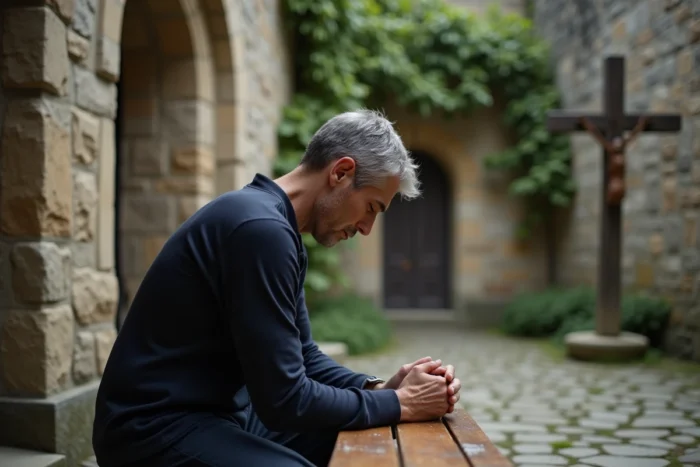
The communal dimension plays a complementary role. The Norms for the Christian Initiation of Adults published in 2024 by the Dicastery for Divine Worship reaffirm a step-by-step journey, with liturgical times and group exchanges. This is not a coincidence: Christian faith is rarely built in complete isolation.
Joining a Bible study group, participating in a worship service or mass, exchanging with other believers, are all practices that nourish faith in a way different from solitary reading.
Life transformation through faith: what it really means
The word “transformation” may seem grandiose. In the biblical context, it refers to a specific passage: Romans 12:2, where Paul invites a renewal of the mind to discern the will of God.
In practice, this transformation manifests through gradual changes.
- An increased ability to step back from daily conflicts
- Life choices aligned with values of justice, compassion, and truth
- A decrease in anxiety related to feelings of loneliness or absurdity
- A concrete commitment to others (volunteering, listening, helping)
Transformation is not a one-time event but a continuous process. People who testify to a radical change overnight often describe an initial trigger, followed by months or years of deepening.
The Gospel does not promise the absence of difficulties. It offers a framework of meaning to navigate through them, and a community to face them together.
Discovering the Christian faith today involves accessible tools: a Gospel, a notebook, a few minutes of silence, and the willingness to put into practice what one understands. The rest is built step by step, without haste, at each person’s pace.