A neighbor mowing two meters beyond their plot, a flower bed encroaching on the pathway, a delivery person cutting through your garden due to a lack of visual markers: the absence of a fence does not mean the absence of boundaries, but it makes these boundaries invisible in daily life. Defining your land without a fence requires combining visible physical markers with a solid legal foundation; otherwise, the slightest dispute between neighbors can turn into a tug-of-war.
Ground markers and materials: setting markers that everyone understands
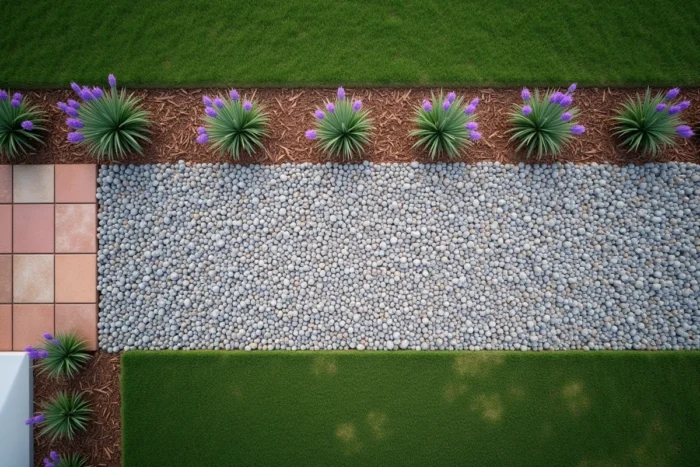
On a flat and open plot, the most straightforward method is to create a visual break on the ground. This can be achieved by changing the surface: a strip of light gravel between two lawns, a row of self-sufficient pavers, or a low wall (three to four rows of concrete blocks dressed in stone) that does not require any prior declaration in most local urban plans (PLU).
See also : How to Stop Telepathy: Effective Methods and Tips to Regain Peace
The choice of material depends on the soil. On clayey land that swells in winter, wooden borders eventually warp within two or three seasons. Corten steel or aluminum borders hold up significantly better, even though their initial cost is higher. Flat slate tiles also work, provided they are supported on a bed of stabilized sand.
To quickly compare Agri Systems’ practical solutions allow you to visualize options suited to each land configuration, with or without posts.
See also : Discover Christian Faith and Biblical Teachings to Transform Your Life
A common pitfall is to place these markers “by eye,” relying on memory or an old fence that has disappeared. Without prior boundary marking, a ground marker has no legal value. We’ll return to this later, but remember that a change in surface marks usage, not ownership.
Low hedges and plants: defining a plot with vegetation
A one-meter-high free hedge is sufficient to signal a boundary without blocking the view or creating excessive shade. However, not all plants are suitable for this purpose.
Species suitable for low delimitation
- Buxus remains the classic choice for structured borders, but it requires two trims a year and is susceptible to box tree moth. It is reserved for short linear arrangements.
- Lonicera nitida grows quickly, tolerates poor soils, and can be easily trimmed to less than one meter. Its maintenance is limited to an annual trim in most regions.
- Ornamental grasses (miscanthus compact, pennisetum) create a soft visual barrier without trimming, but they disappear in winter depending on the variety.
- Lavender works well in dry climates and marks the boundary with its color and volume while requiring little water.
The main point of caution concerns planting distance. In the absence of contrary local regulations, the Civil Code requires planting at least fifty centimeters from the boundary for plants under two meters. Checking the local urban plan before planting avoids forced removal a few months later.
Combining plant and mineral
A row of lavenders paired with a flat stone border provides a strong visual signal without height. The advantage of this combination: if the hedge takes two years to thicken, the border provides a marker from day one. Opinions vary on this point, but it is observed that mineral alone seems too dry in a landscaped garden, while plant alone lacks clarity in winter.
Boundary marking without a fence: securing the property line
Installing borders or planting a hedge makes the boundary visible. But visible does not mean legal. The cadastral plan, which many property owners consult online to locate their boundaries, has no legal value for establishing a property line. It is only used for tax administration.
The only action that can be opposed to third parties is the contradictory boundary marking carried out by a licensed surveyor. The surveyor summons both neighbors, measures, places standardized markers, and drafts a report. This document can then be published in the land registry.
This step does not require the installation of a fence. One can perfectly have buried markers at the corners of the plot and delineate the boundary with a simple strip of vegetation or a change in surface. Boundary marking protects the limit, the marker makes it readable: the two complement each other.
Lighting and furniture: defining an outdoor space without a physical barrier
In a shared garden or a co-owned plot, installing a hard border is not always possible. Lighting then offers a discreet yet effective alternative.
Low solar light posts, spaced every two to three meters, create a visible line as night falls. During the day, their physical presence (posts thirty to forty centimeters high) is enough to signal a passage. They can be combined with wooden or steel planters, placed without a foundation, which mark the boundary while accommodating aromatic plants or grasses.
Garden furniture positioned in a line creates a psychological boundary without any regulatory constraints. A bench, a series of vegetable planters, a row of pots: these elements guide circulation and discourage unintentional crossings.
Local urban plan and local constraints: what the town hall really allows
Before investing in landscaping, consult your local urban plan regulations. Several points deserve attention:
- Some local urban plans require fences in residential areas, making boundary definition without a fence non-compliant.
- The maximum allowed heights vary depending on whether the boundary faces a street or a neighbor. The recent trend in several municipalities is to limit solid walls facing the street, favoring low or vegetation alternatives.
- In natural or agricultural zones, restrictions may prohibit any constructed element, including a low wall. Vegetation then becomes the only option.
The town hall’s urban planning department provides this information for free. A quick visit before construction can prevent a notice of restoration.
Defining a plot without a fence is based on a simple principle: making the boundary visible without building a barrier. The combination of formal boundary marking, a physical marker suitable for the soil and climate, and a check of the local urban plan covers the three main risks (neighbor disputes, non-compliance, premature degradation). The rest is gardening.